Jazz’s essential spontaneity does not always arise from music-making on the hoof. Often, it’s written down to be read and played as though it were being extemporised. Within that framework, of course, jazz always makes room for the ubiquitous solo, in which musicians can extend themselves.
These thoughts arose at pianist Alex Hutton’s guest appearance with the Black Mountain Jazz Collective – its house band – not least because rehearsal time on these occasions is often recorded in multiples of minutes rather than hours. The musical structures and protocols thus arising might be expected to be ragged and under-developed; but, most of the time, they result in the sort of endearing informality that makes small musical miracles sound even more miraculous.
First, something about the Collective. It was formed from a few musicians with Welsh connections, some with backgrounds in academia on the Jazz course at the Royal Welsh College of Music and Drama in Cardiff and/or with regular South Wales appearances on their rosters. It’s currently composed of Jack McDougal (Jack Mac) on saxophones, Ryan Thrupp on drums, and Nick Kacal on acoustic bass. It was set up by BMJ, itself a non-profit-making club, as a resident combo with a twin function: playing with guests at public concerts and leading workshops for aspiring young jazz musicians in the Abergavenny area. Some clubs without a house band find themselves paying for soloists and their accompanying musicians. So there’s a financial dimension to the idea.
The appearance of the Collective with Hutton presented a useful opportunity to gauge the success of the arrangement. Jazz activity at club level is such that all these musicians will probably have come across one another before. But at Abergavenny now, a stage has been reached at which the Collective is not just a background accompaniment to a stellar soloist – and Hutton is certainly that – but a trio intent on integration and bringing out the best in their visitor.
Yorkshireman Hutton, now London-based, has attracted attention with a number of landmark albums, most recently in the UK jazz firmament with two by his trio, one augmented by guest instrumentalists and a vocalist. His regular trio of himself, bassist Yuri Goloubev and drummer Asaf Sirkis might indicate the sort of robust playing needed to match his capacious energies, which a few times involved reproducing the sound of a West Indies steel band with two-fisted chords. Kacal, Mac and Thrupp (the original drummer and Collective instigator was Alex Goodyear, now making a name with the Jon Lloyd European Quartet and others and fast becoming known on the Continent) has long won the respect of guests, Hutton no less than any of the others.
As might be expected of a pianist with such a cornucopia of deft, pianistic touches and a muscular attack incorporating two-handed equanimity, Hutton’s interests are wide – folk, classical (from which the richness of his pianism probably derives), pop, and jazz modernism – but never coalesce into an indeterminate mulch. A couple of years ago in my Jazz Journal column, I suggested ways in which a small jazz ensemble might explore permutational variety to avoid mind-numbing repetition. One was to break the group into smaller units, which is what Hutton did here, reducing the quartet to a trio for pianist Bill Evans’s Waltz for Debby, a tune made famous by the Evans piano threesome, and a piano-tenor sax duet for I’ll Be Seeing You, in which both Hutton and Mac contributed equally. Mac has been in terrific form on the melodic aspects of these collaborations, shooting lengthy fusillades of double-time improvisations while, as always, never forgetting the sax’s antecedents in honking genres of music linked closely to jazz. Hutton was the same, introducing the folk elements of Shenandoah and Barbara Allen to what was always a jazz setting, typified at the end by Tea for Two. Thrupp, in particular, helped establish that setting as well as laying the uncompromising rhythmic foundations for pop and Latin items and taking a number of extended solos that enthralled Hutton and the other two. In fact, all four musicians engaged with each other’s input. A jazz group can often reap the benefit of mutual admiration among its members, as these Collective get-togethers continue to prove.
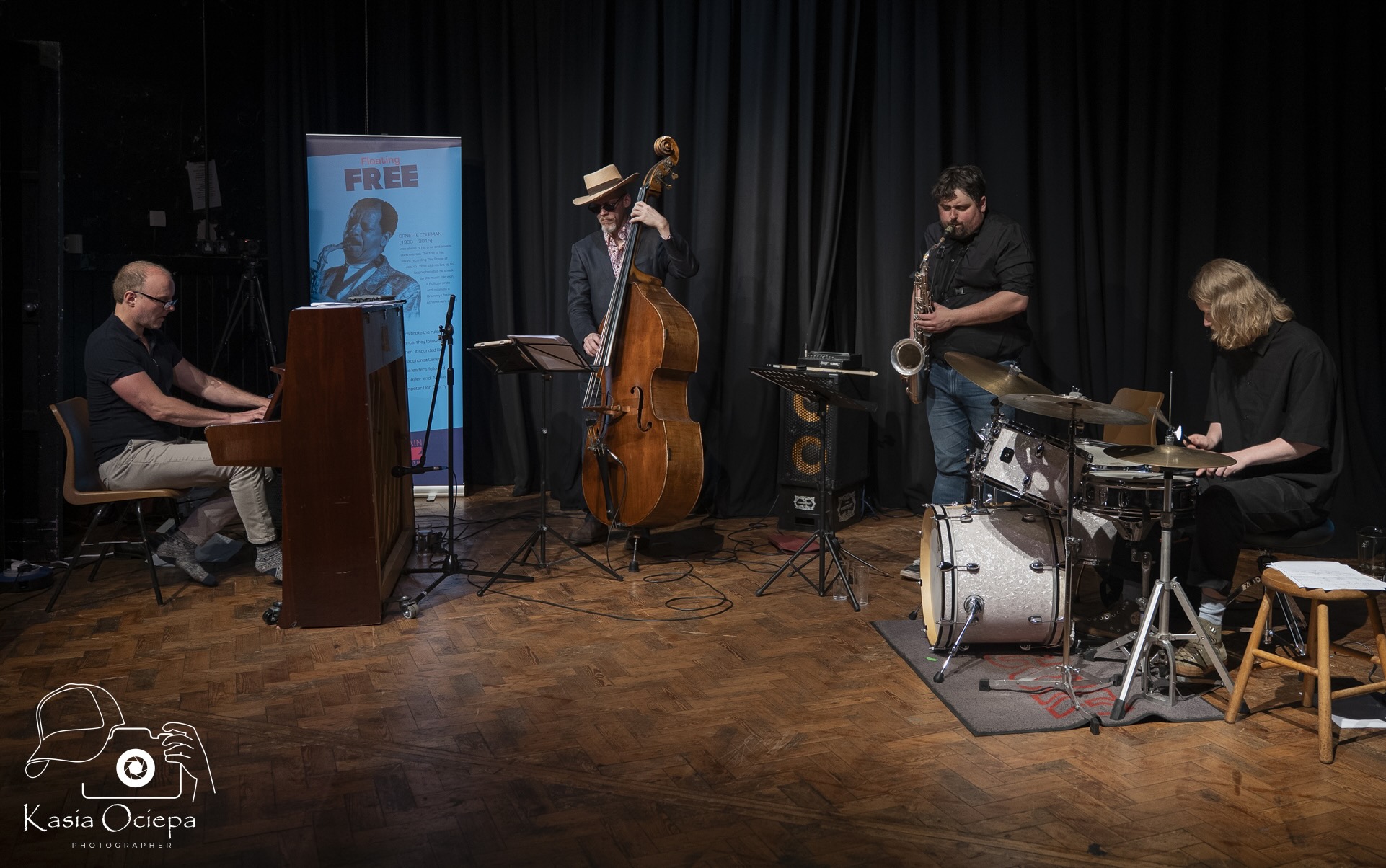
Caption:
Alex Hutton (left) with Nick Kacal (bass), Jack Mac (tenor sax), and Ryan Thrupp (drums). Photo: Kasia Ociepa