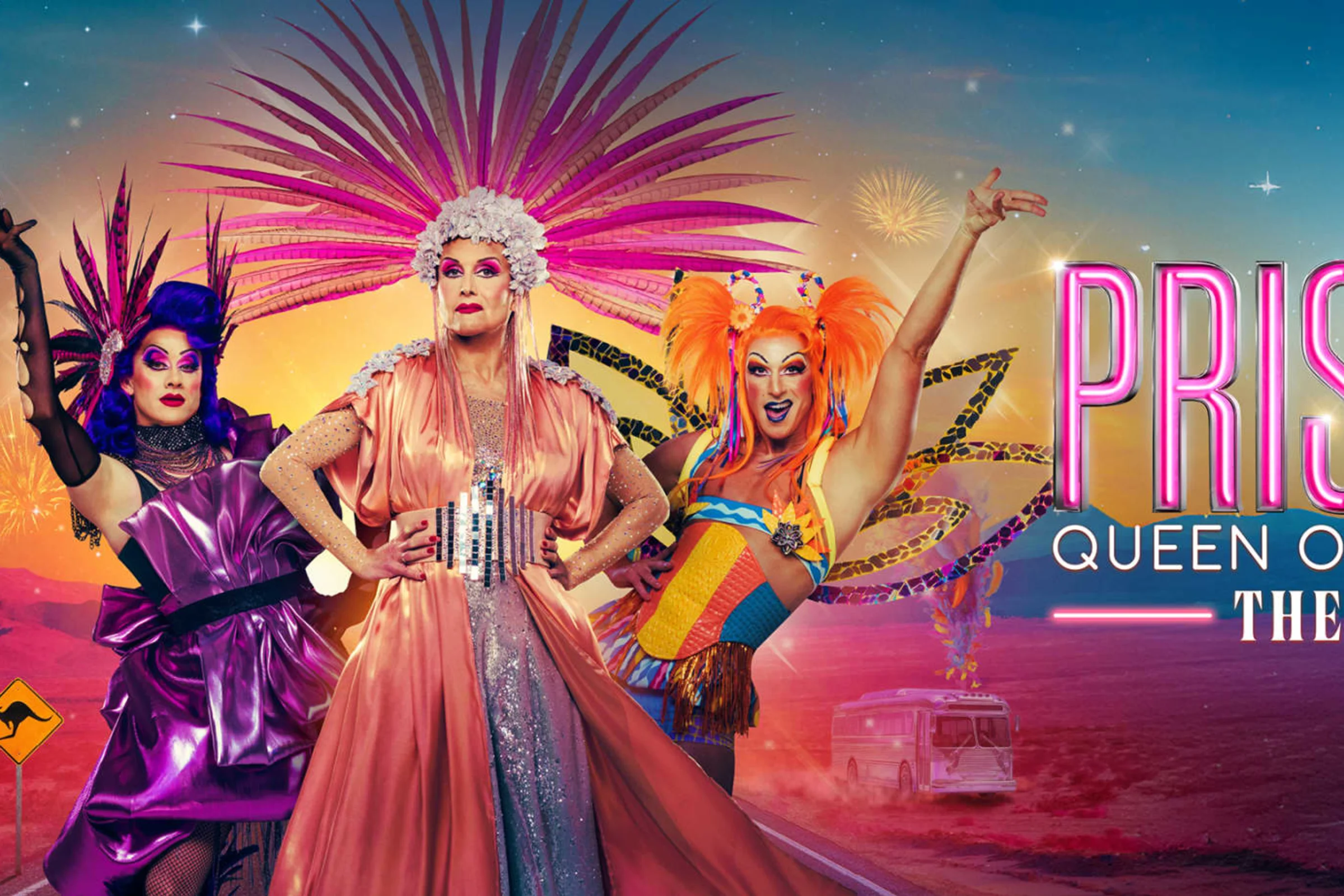
It is pleasantly hard to believe that it’s been over thirty years since The Adventures of Priscilla, Queen of the Desert first hit the cinema screens. Coming to UK stages on tour in musical form for the direction of Olivier nominee Ian Talbot OBE, after getting accolades on both Broadway and the West End, it feels not just still relevant but to some extent also revitalised, capable of speaking to an audience on some levels which were only partially accessible, by virtue of the times, to its original.
There is something quietly comforting in the realisation that this particular piece of beloved queer media, differently from many of its peers, does not feel hopelessly dated by now. For anyone who grew up queer in the 90s and noughties, Priscilla has an inevitable emotional charge that is hard to shake. Pop culture media providing representation, and positive representation as that, were hard to come across then; one clung to what little could be found, and what could be found was often sombre in tone, with little hope of a happy ending.
In this cheeky Australian desert romp, on the other hand, a happy ending seems more than attainable, and what’s more, attainable without having to sacrifice any aspect of one’s identity: protagonist Tick AKA Mitzi (played here by Kevin Clifton) gets to be a drag queen, and a valid member of the LGBT+ community, and a father, without any of the three impinging on each other; perhaps even more remarkably, his co-star Bernadette (very sharply delivered by Adèle Anderson) gets to be a trans woman and find a place of happiness in a respectful relationship. More than that, Bernadette is represented with respect and empathy, as a whole person rather than a caricature or a stand-in for a vaguely defined group; that’s better representation for trans people, in 1994, than you’d be pressed to find in a lot of contemporary media.
On this last count, the musical improves on the film by at last casting an actual trans woman, rather than a cisgender man, to play the role, and Anderson’s performance adds a layer of tact and understanding to it which is very much welcome, without losing any of the bite that made the character so charming in the first place. In a time where LGBT+ rights and trans rights in particular feel far too often under threat, there is a second level of comfort offered by this production of Priscilla, which goes beyond its nostalgia value.
Not that all parts of the story have aged equally well. Open-minded mechanic Bob (Peter Duncan) gets an ever-so-slight makeover which deftly expunges some of the more controversial aspects of his original characterisation, but there is little to be done to avoid the feeling that the presentation of his go-go dancer wife Cynthia (Isabella Glanznig Santos), originally played fully for laughs, complete with excessive accent and stereotypes galore, still reads somewhat racist no matter how much the new production tries to avoid lingering over those specific aspects. It’s entirely fair to see these cracks and wonder whether the production would have been able to do more to address them, or whether the attempt would have skewed too preachy; the encounter with the aboriginal Jimmy (Sario Solomon), also much amended compared to the film, now feels like it’s leaning too much towards the latter, with the character noting, a little too pointedly, that he wears traditional attire only to appease the gaggle of tourists following him around.
It is the discussion for the ages: is it better to accept those flaws as an inevitable byproduct of the time in which a work was conceived, and leave them as part of a whole, or try and put a patch over them, at the risk of introducing a jarring note?
There are a few more modernisations in the text of the musical, albeit of a more low-stakes nature: Drag Race aficionados will find themselves smirking at the debate between Bernadette and Felicia (Nick Hayes) on whether there’s more artistry in lip syncing or original vocals, for instance. Some work better than others, but overall the musical maintains an even beat and is consistently entertaining, aided in no small measure by a jukebox of absolute classics ranging from Go West to I Will survive by way of La Traviata (although: where have ABBA gone?)
One of the strengths of the work, from its inception, has always been its joyfulness: its ability to portray lived queer experience in a fashion that does not shy away from the ugly parts without ever snuffing out its light, and which remains ultimately colourful and entertaining. And entertain the musical does, from the early beats of hinted-at audience interaction to the impressive choreographing. As for colourful, the costumes, designed by Strictly’s own Vicky Gill, draw from some of the more iconic visuals from the film and add more of their own in a way that feels faithful to the original mood. Costumes are an important part of any drag show, and so it naturally follows that they must be a significant component in the success of a show about drag.
All the main cast manages to strike precisely the right tone throughout, from scene to scene, knowing when to make the press of jokes and innuendo a little more relentless so that a moment can feel poignant, and it doesn’t much matter, in the end, that the accents are a little all over the place: for a story that is so quintessentially Australian, after all, Priscilla feels remarkably universal.
On a less existential note, it was nice to see that the WMC seems to have resolved its woe with volume: a few recent musical productions had suffered from the volume being so high that part of the flair of their vocal performances was lost in the process, but here there was no such issue and everything came through crisp and clear.
A fairly age-diverse audience (always nice to see for a work that draws from this kind of source materials) seemed to be having a great deal of fun and, one hopes, that same audience might then have gone home with a few new interesting thoughts on what being LGBT+ actually means in real life. To foster those thoughts was, all fun aside, the original power of Priscilla, and it is nice to see that particular kind of magic remains alive and well in this latest incarnation.
Until April 25