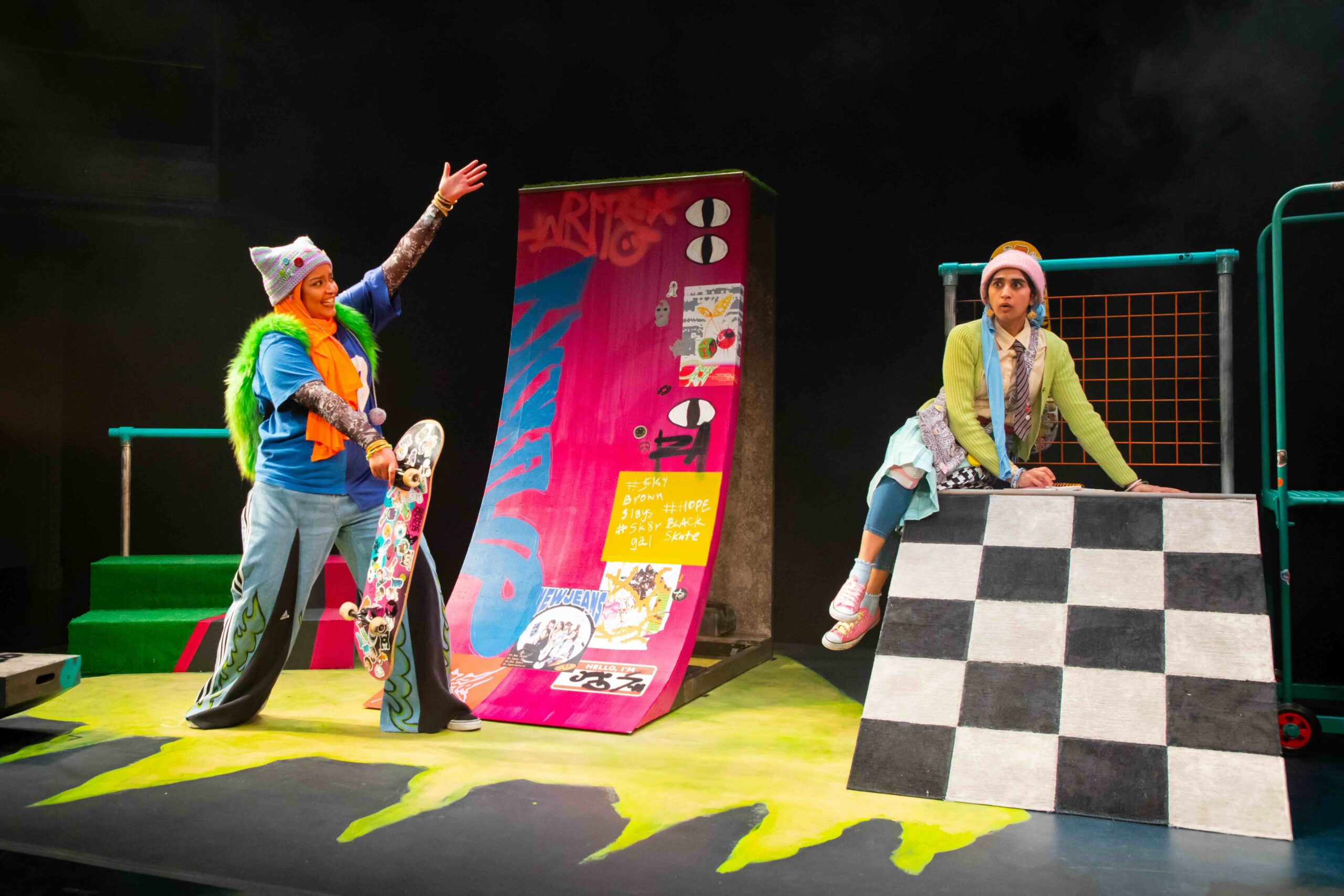
Sisters360 is a funny, high-energy family play, written by playwright Asif Khan (Tartuffe, RSC; Combustion, Arcola Theatre) after coming across the inspirational story of the so-called ‘Hijabi-sisters’. Produced by Turtle Key Arts, this family play follows step-sisters Fatima and Salima as they chase their dream of winning the Tiny is Mighty competition, inspired by Olympic medallist Sky Brown, while navigating the threat of family separation.
As a British Muslim, I’m always looking for stories that can break the many negative stereotypes about Muslims. I realised this was one straight away. Sisters, aged 10, who wear the hijab and skateboard. That on its own, immediately breaks so many stereotypes, not just about Muslims, but also about girls. Visually, it was a very attractive idea, having these characters be the leads of a play with all the possibilities related to skateboarding: the graffiti, the clothes, the attitude, the skateboard slang etc. It all made for a very action packed, fun play and we just don’t see Muslims in these types of roles. I thought it would be very inspirational for girls and boys from a Muslim background to come see this, but also for girls and boys from every background and faith.
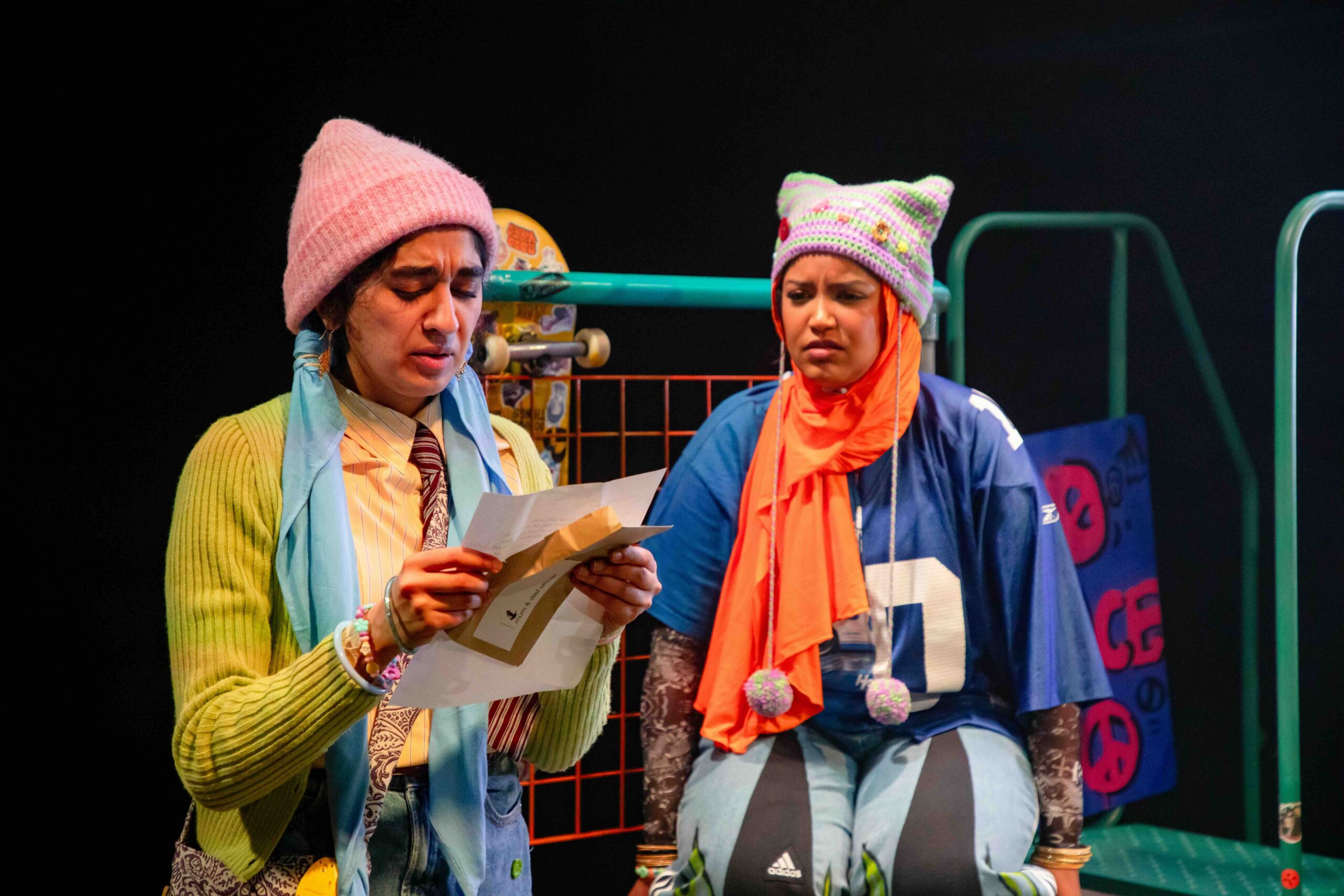
To get into the world, I first chatted with the sisters from Hull, with their mum and watched lots of the videos that they had posted on social media. It was helpful to hear children of that age speak and the vocabulary they use. I also have children of my own and I regularly hear the way they talk to each other. You have to put yourself in the mind of a child, the dreams you have as a child, the excitement, how children see the world. What matters to these children? What are their ambitions? I realised when researching skateboarding that there is so much funky language involved, for example there are names for each and every trick. There’s a lot of social media involved and many skateboarders have their own channels and film their own tricks.
I approach the writing in the same way I do when writing adult plays. It’s just that the characters are children. Your imagination plays a big part when writing children’s plays, you can go into the weird and the wonderful, let your mind be free. When I’m writing characters, I want to create good role models, but also allow them to be a little bit cheeky, naughty and mischievous and make it fun for kids to watch. When researching, I watched a lot of Sky Brown, who became an Olympic medallist at 13 years of age. One particular bit of footage showed her trying to do a trick on a halfpipe, failing, falling, getting up, casually walking back, trying the trick again, falling, getting up, walking back, trying the trick again, there was no frustration in her. She was falling and failing numerous times. It was just part of the process of being a skateboarder, you fail and fail and fail, but you persist and persist and finally you get the results. It’s a good metaphor for life. I loved playing basketball as a child, and my hero at the time and still is Michael Jordan. He was someone who captured the meaning of hard work. He was not only talented at what he did, but he also worked harder than everyone else. He had that ‘I’m never going to give up’ mentality. I always tell my children that I don’t care what the result is, as long as you do your best. I think that’s a good thing for children to learn, because life is full of obstacles and you experience failure and disappointment many times. But it’s about what you do after you’ve experienced failure, what did you learn from that? How do you take those lessons into the future? I think the sisters in this play have that mentality, of never giving up, being determined and even with the challenges that they face in life with their parents, they are always striving to have their way. They’re so determined to be together and skateboard together.
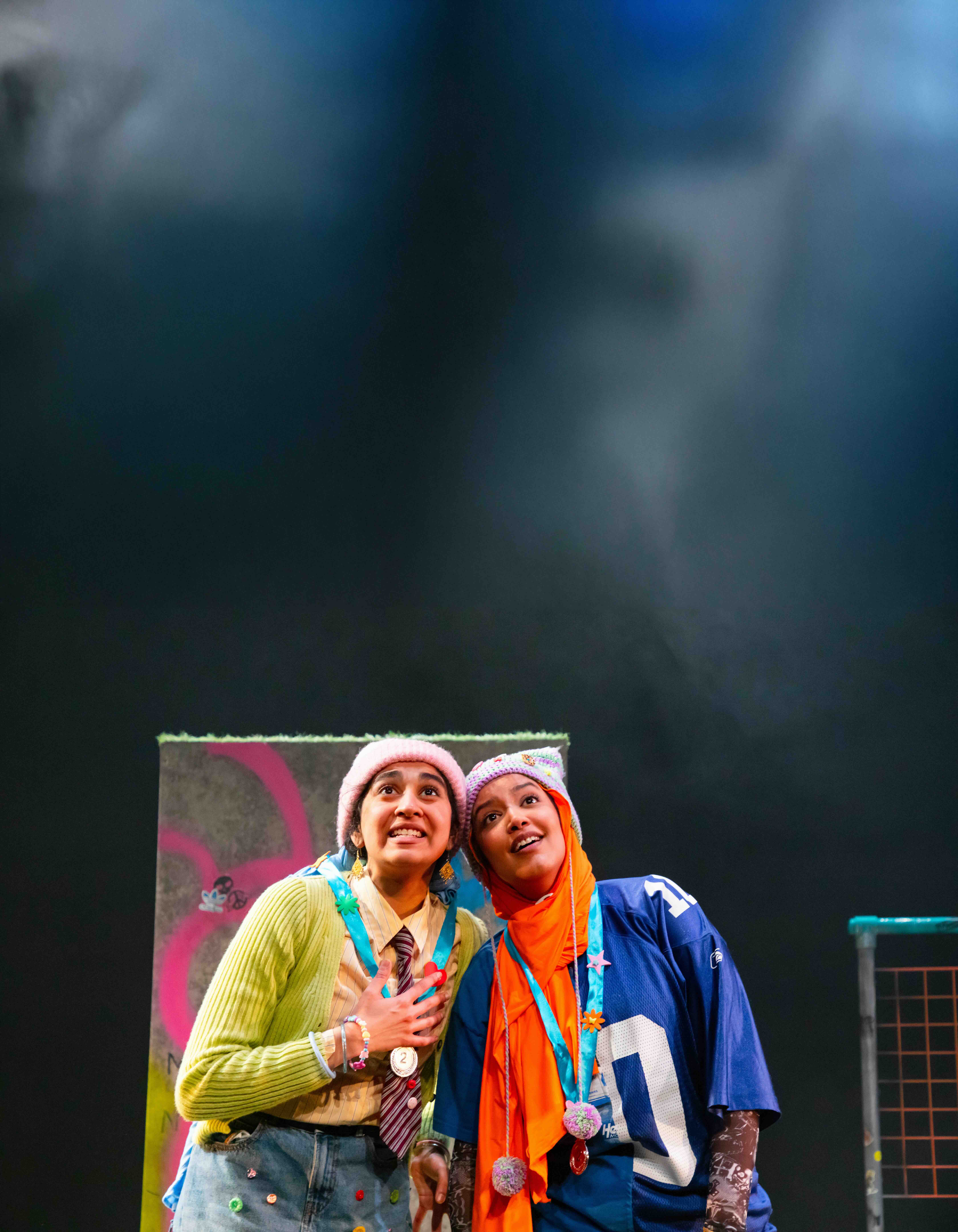
It’s important as a playwright to create, first and foremost, a play which is enjoyable, gripping and entertaining. Everything else follows, but the play has to be engaging, exciting, it has to connect with the audience, it has to make the audience feel something, laugh, cry, it has to connect with everyone, not just Muslims. Fundamentally, this is just a play about two 10-year-old girls, step-sisters, who want to skateboard, or even more simply, two 10-year-olds, who have a dream, and that is what any child can relate to. The Muslim aspect will naturally be embedded in the play because the characters happen to be Muslim, but they could easily not be Muslim. I think that on its own, it’s a story about two girls who want to skateboard, who just happened to be Muslim, goes a long way and breaks stereotypes and allows young Muslim children in the UK to feel represented. I want children to be able to look at someone who is brown or black and Muslim, who wears the hijab, and see them as their hero. Why can’t we have heroes who are Muslim? I hope children from all backgrounds, boys and girls, look at the characters on stage and think ‘they’re so cool, I want to hang out with them’. I hope parents who come to watch are also absorbed and entertained by the story. Someone sent me a message, saying that their seven year-old daughter watched the play last year, and still talks about it, and how important it is that her seven year-old Muslim daughter saw my play and characters that looked like her. How it still remains strong in her memory. I responded by saying that her words made me so happy. I meant it. It’s why I write.
Sisters360 stops off in Aberystwyth on Saturday 27th June at the Aberystwyth Arts Centre