While musicianship and artistry remain the most essential elements of any opera experience, the importance of ambiance and the pleasure of the venue cannot be denied. West Green House Opera combines superb performances by both young and seasoned singers, a commitment to musical excellence from its players, and an idyllic setting in a Hampshire garden.
As a newcomer to this opera company, it is worth noting that this is its Silver Anniversary season. Over the years, it has seen many changes, developments, and challenges (such as Covid-19), along with an impressive catalogue of works and performers. Many of these are household names (in the opera world at least), but crucially, many young singers have been – and continue to be – given valuable opportunities.
There are strong links with opera practitioners as well as singers, and so this season, for example, sees the return of Jonathan Lyness and Richard Studer of Mid Wales Opera which has recently been saved from closure after the loss of Arts Council funding. They are presenting a new Macbeth, the Verdi opera Mid Wales Opera performed several years ago. This perhaps also explains the large contingent of excellent Welsh singers. It is being performed on West Green House Opera’s main stage, the Green Theatre, with the stunning West Green House as its backdrop.
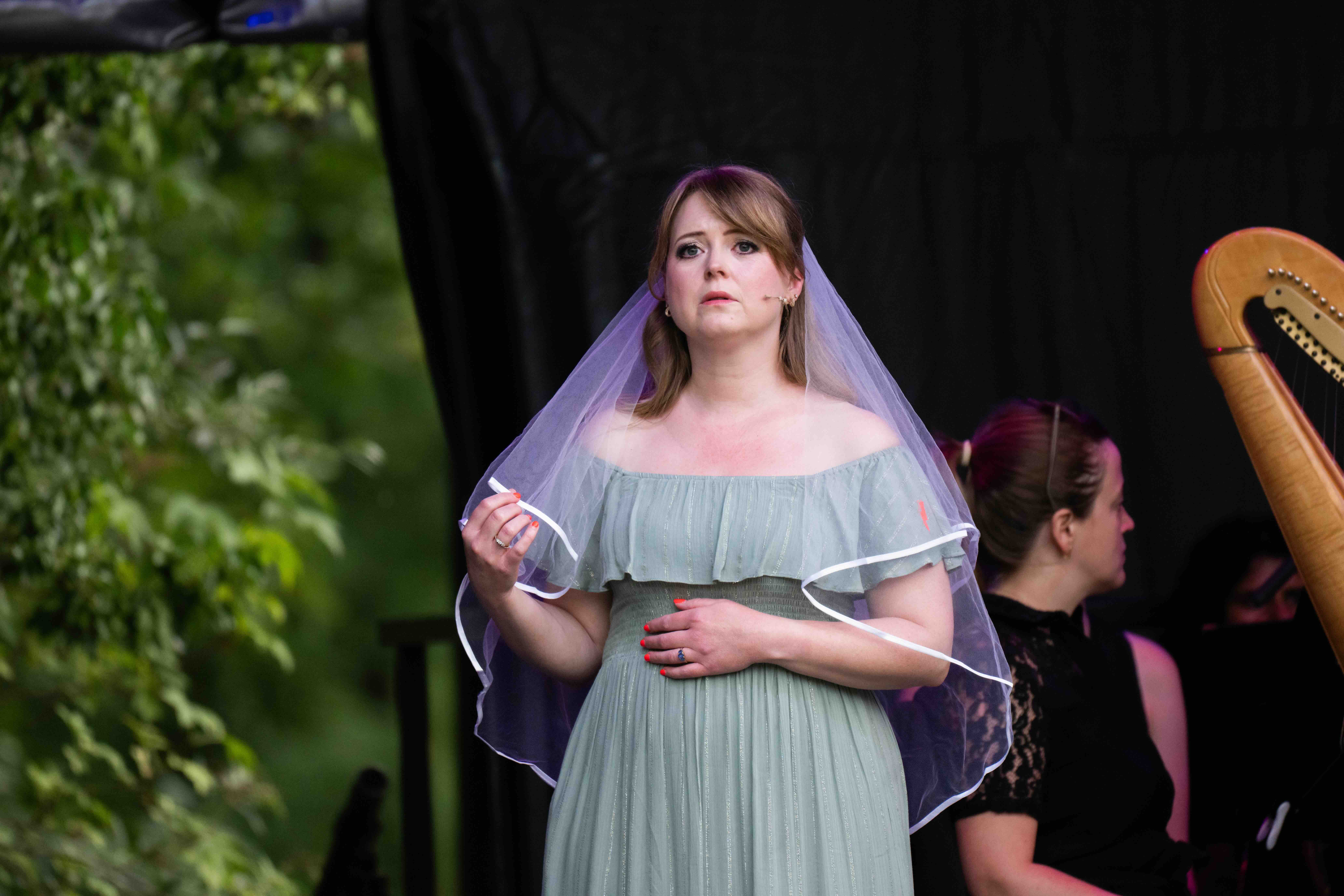
Fflur Wyn
The season opened with a polished performance of Bellini’s I Capuleti e i Montecchi, staged in The Island Theatre. The small orchestra and cast, in a semi-staged production directed by Lysanne Van Overbeek and cleverly lit by Sarah Dell, performed on the island while the audience sat cabaret-style at tables in a marquee on the mainland. The marquee has one end open, facing the lake and therefore performers. This setup requires amplification, though it is not a major issue. The only drawback is that when characters are on the ground (as dying characters often are), they are hard to see from the unraked marquee seating.
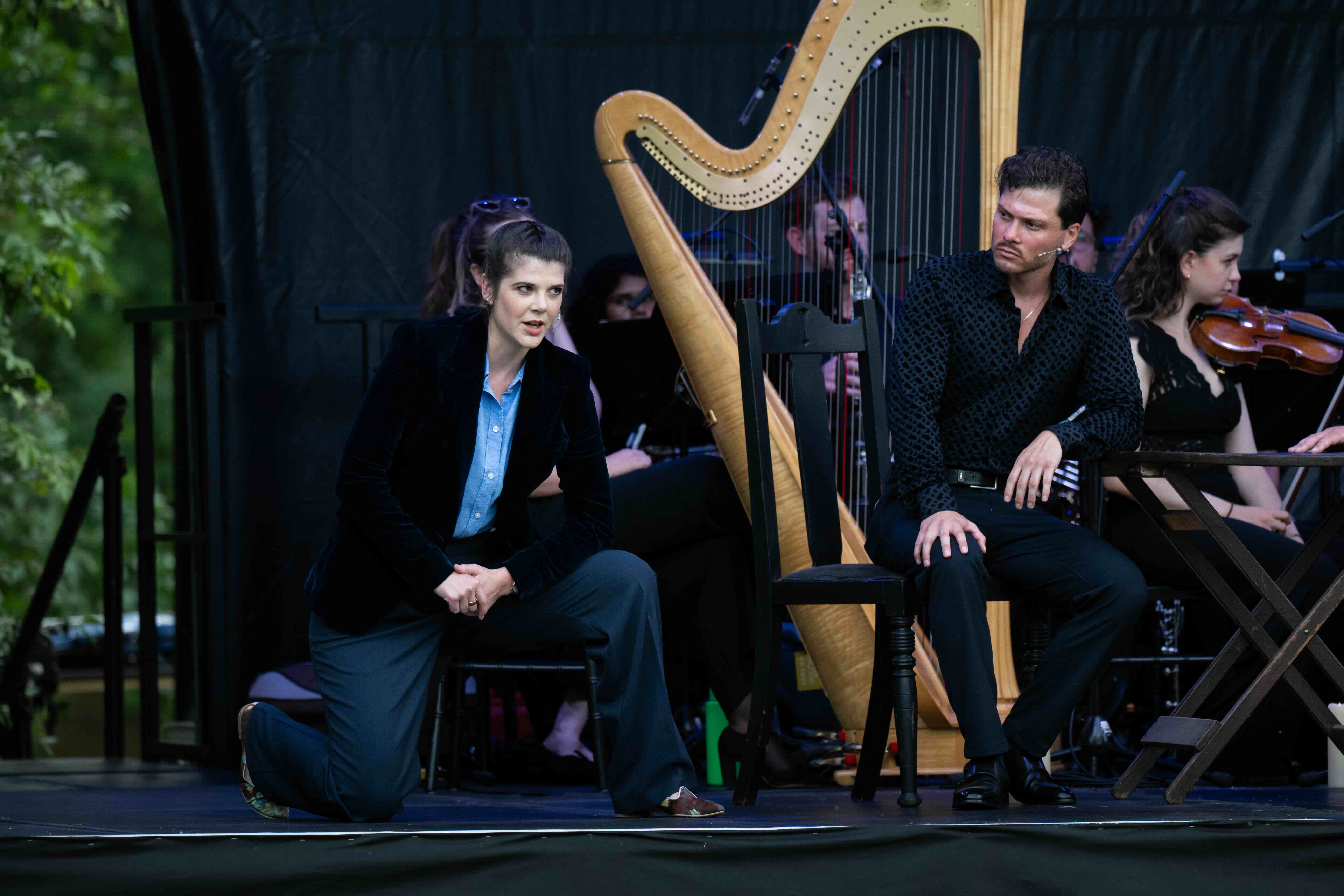
Katie Coventry and Julian Henao Gonzalez
With Fflur Wyn as Giulietta and Katie Coventry in the trouser role of Romeo, we had two thrilling exponents of Bellini’s bel canto. The blending and contrast of soprano and mezzo voices was exceptional. Wyn, as always, displayed excellent phrasing, glittering ornamentation, and a strong natural dramatic instinct. Her showstopper “Oh! quante volte” was a highlight. Coventry delivered a rich, powerful performance, balancing intensity with tenderness and grief. Coventry has plenty of stage presence, here just in shirt and trousers, her hair looking just natural, rather than any pretence of playing a boy.
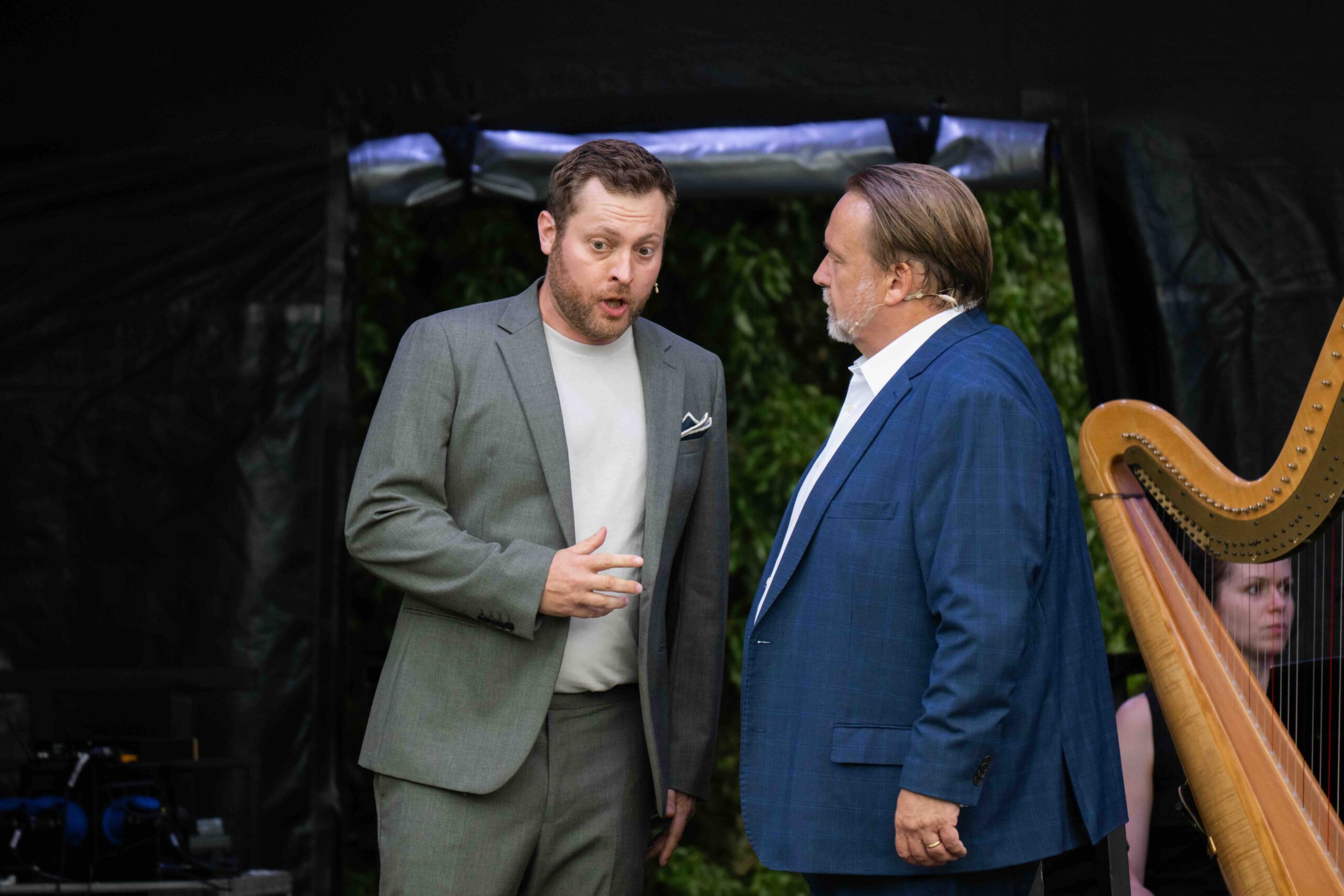
As Tebaldo, Julian Henao Gonzalez’s golden-voiced tenor was so appealing that one could almost understand Giulietta being swayed by his advances. Timothy Nelson sang and acted a sympathetic and nuanced Lorenzo. Always a strength in any production, Henry Waddington (who has sung Lorenzo earlier in his career) gave Capellio (Giulietta’s father) the necessary gravitas with a sonorous and commanding performance. They too were dressed in modern attire.
Timothy Nelson and Henry Waddington
There was no chorus, and this required some imagination from the audience – particularly when the local ducks and geese contributed their own vocalisations. Still, it added to the charm of the evening.
Conductor John Andrews drew out the exquisite, flowing Bellini melodies from the Orpheus Sinfonia players and, in this intimate setting, allowed the sound of individual instruments to shine in beautifully phrased solos, all within a well-paced reading of the score. While the small scale makes it challenging to fully convey Bellini’s martial music and the gang warfare (inspired by the 1818 Italian play by Luigi Scevola rather than Shakespeare), the performance retained its emotional core.
At the beginning of the opera, Romeo and Giulietta are already engaged in a secret affair, aided by their friend Lorenzo, who is also the family doctor (hence the potion). Romeo is in hiding, having killed Giulietta’s brother. Her father arranges her marriage to Tebaldo, who also loves her. Giulietta fakes her death in despair, but Lorenzo’s message fails to reach Romeo, who – unaware of the ruse – goes to her tomb, as in Shakespeare’s version.
As dusk fell, the gardens created by the opera company’s founder, Marylyn Abbott, provided a deeply atmospheric backdrop as the tale descended into the despair and tragedy of the star-crossed lovers.
The company’s Artistic Director, tenor Tom Elwin, clearly shares the philosophy of his predecessors: nurturing young talent, maintaining and developing relationships with singers (including those appearing this season), and taking measured risks with repertoire and the use of the gardens, lake, and house as production spaces. Elwin also features in the company’s Silver Anniversary concert.
After the performance, the grounds are beautifully illuminated, offering yet another perspective on what the company fittingly calls itself: The Opera Garden.
Images by Matthew Williams-Ellis
In addition to Macbeth (July 19, 20), the season includes Oz and Armonico: The Fairy Queen (a collaboration with wine expert and raconteur Oz Clarke and the Armonico Consort & Baroque Players, July 22); Donizetti’s Don Pasquale in the Green Theatre (July 26, 27); a lunchtime concert with the National Opera Studio at the Island Theatre; and the Silver Celebration Opera Gala in the Green Theatre, featuring the BBC Concert Orchestra and soloists Ermonela Jaho and Thomas Elwin (July 25).
Mid Wales Opera autumn tour of Bernstein’s Trouble in Tahiti starts on November 7.