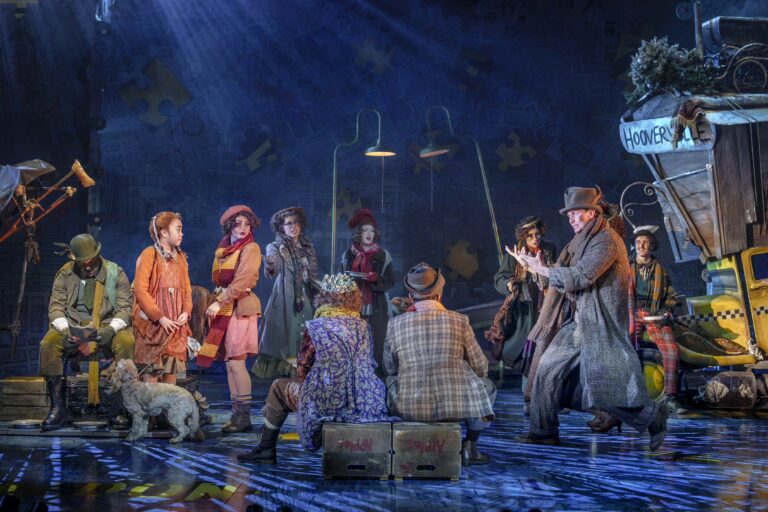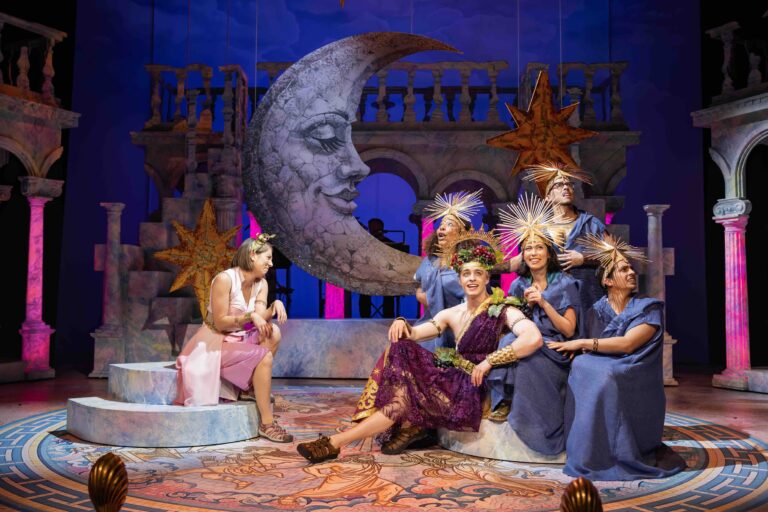
How many times, and in how many variations, has Romeo and Juliet been retold? Attempts to shoehorn a feminist interpretation into a play that, of all of Shakespeare’s plays, has proved to be one of the most particularly resistant to it have abounded in the past, none of them especially successful. This Broadway musical take starts from what promises to be a very clever intuition: rather than retell the story from a different angle, it writes a new one, starting where the Bard’s work ends – the narrative device being that Shakespeare’s wife Anne convinces him to draft an alternate version of the tale where Juliet doesn’t die, but rather goes off on an adventure to Paris with her nurse and a pair of friends and, inevitably, hijinks ensue. It is an ingenious ploy: it allows for the empowerment of the character to be the focus of a new narrative, that does not have to deal with the established events of a story which is certainly not the best conduit for it. The main tension at hand, throughout, is actually between Shakespeare and Anne – as the latter wants to see Juliet succeed and be free, perhaps as a vehicle to vent her own (more than legitimate) frustrations, while the former wants to put storytelling first, even if the characters should suffer for it.

Jay McGuiness
(Image Matt Crockett)
The main issue & Juliet has is that its Shakespeare character (played by The Wanted’s Jay McGuiness) is fundamentally right on all counts, even when the writing goes out of its way to question him. He is right that a good story needs conflict to be taut and compelling – which is why the first section of the musical feels directionless and scatterbrained in places and it is only after the main narrative conflict is introduced (both through the love story between Frankie and May and through the return of Romeo) that it finally feels like something worth getting invested it. He is also right in that some things simply make narrative sense, and trying to hijack them for ideological reasons simply makes for poor narratives. It makes sense, given the setup, for Juliet and Romeo to end back up together at the end, but this goes at least partly against the ideology of carefree independence the musical has been setting up, and so the writing ends up fighting the inevitable for an unnecessarily dragged-out time and jumping through hoops just so it can get to that inevitable ending through a more tortuous way that still gives Juliet her ‘girlboss moment’. It feels contrived, and frankly unnecessary, like the writing is working against the story just to prove a point.

Jordan Broatch
(Image by Matt Crockett)
It is a pity, because when the musical truly commits to exploring its characters and their psychology, it does some very interesting things. The parts exploring the relationship between Shakespeare and Anne are genuinely touching, and the exploration is nuanced and far from obvious, certainly not something you’d expect from a tongue-in-cheek jukebox musical. The tension between parental expectation and genuine fatherly love is explored in what is actually a very sensitive way in the storyline of Lance and Frankie. May’s nonbinary character is treated with respect and as a whole person rather than the personification of a category – something that is not necessarily obvious. It feels, repeatedly, like the writing is limiting itself because it feels compelled to constantly remind the audience that Juliet is throwing off her shackles as a liberated woman, when that message could come through all the more clearly, and in all its complexities, by simply letting the story breathe.
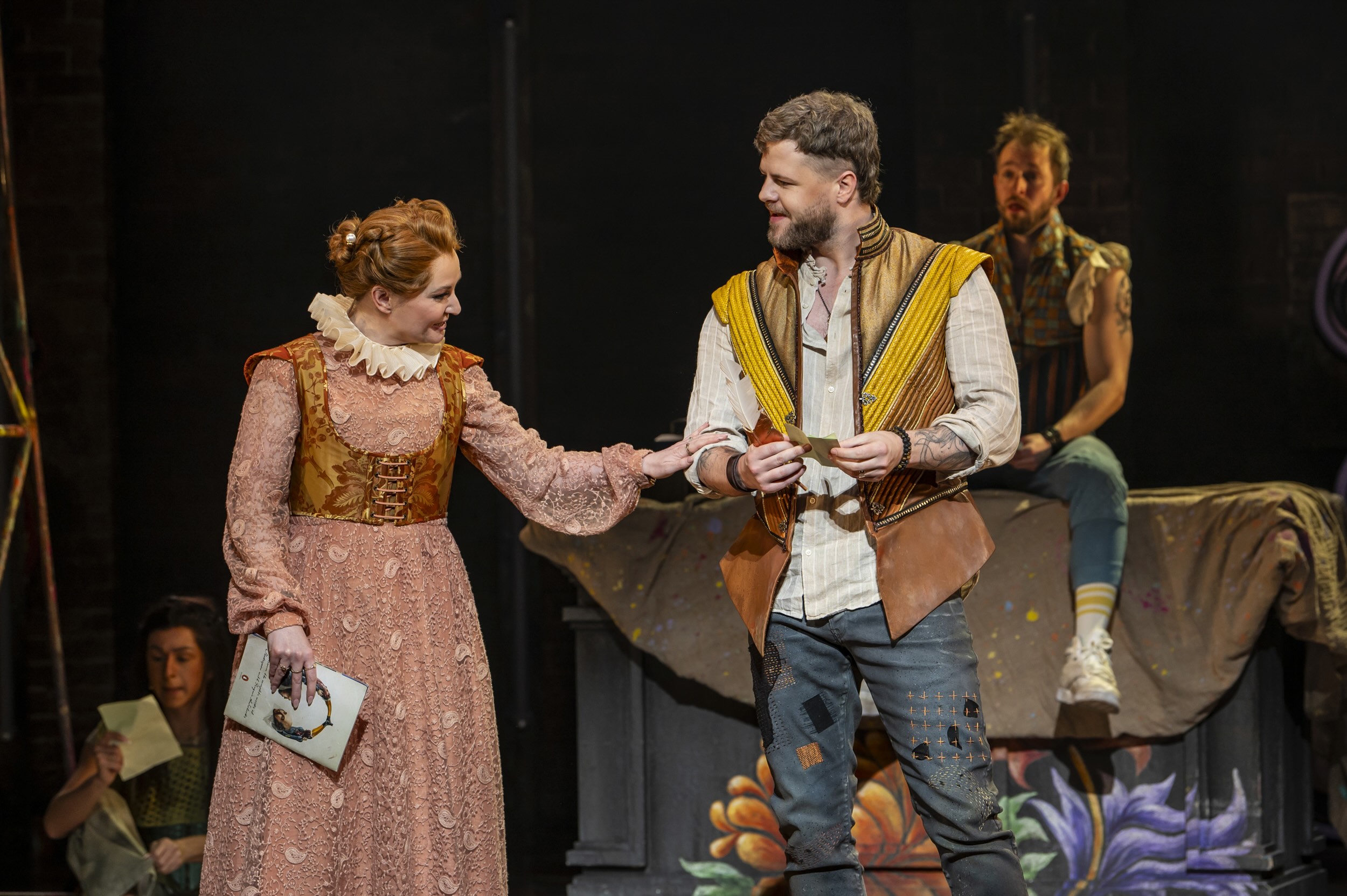
Lara Denning and Jay McGuiness
(Image Matt Crockett)
That is not to negate that the musical is in places genuinely very clever, and in places – several, even – genuinely funny. It has a remarkably good understanding not only of the original play but of the Shakespearian mentality, and its Shakespeare-based jokes are intelligent and honestly hilarious. Its take on Romeo as a glam rock himbo is close to comedic perfection, and from the moment the character (portrayed here by Ben Jackson Walker) appears towards the end of the first act he becomes a continuous focus for audience enjoyment. Juliet herself is endearing if not always relatable, and shown to be so honestly good-natured that it is impossible to reproach her for her blunders. The acting is not always flawless, but there are some excellent deliveries, and the singing makes up for the rest (Gerardine Sacdalan’s Juliet in particular got some very well-deserved applause).

Ranj Singh & Sandra Marvin
Ultimately, though, & Juliet is primarily entertainment, and entertain it does, beyond doubt: it is a genuinely fun night, fast-paced, colourful, with a decent dose of good feelings in it, a very good delivery from the ensemble (although the choreography could have been a little more varied) and some stand-out performances particularly by Sandra Marvin as the nurse Angelique and Jordan Broatch as May. Ranj Singh acquits himself very well as Lance in his first professional musical theatre role, and proves to also be a fan favourite. The musical numbers are on the whole enjoyable – although, on the technical side, the volume was in places too loud, to the detriment of the singers’ delivery – in a fast-and-furious way that stands squarely in the Moulin Rouge! tradition. One might, perhaps legitimately, question whether we truly need any more juke-box musicals, or whether this particular story would have benefited from tailor-made musical numbers rather than by shoving in all sorts of pop music favourites (it probably would have), but as far as juke-box musicals go this is a very ingenious one, which constantly strives to do new things with the materials it has rather than just stick choreography onto a popular song: for instance, some of the lyrics are split into duets so that their originally individual point of view becomes a conversation, and this is in places very effective (and besides, it is undeniably funny to see Juliet launch into Oops! I Did It Again after rushing into yet another marriage with someone she’s only just met).
Perhaps the best approach to & Juliet is to take it for what it is: somewhat unsubtle, somewhat on-the-nose, narratively clunky in places, but genuinely committed to its characters, interested in actually telling a new story starting from the well-known premise and in doing something more with the juke-box musical format, and determined to entertain. Approach it as such, and you’re probably guaranteed to have a very enjoyable night. After all, Shakespeare’s plays were meant for entertainment, too – something modern audiences and critics far too often forget.
Main image: Ben Jackson Wales and Geradine Sacdalan. (Image Danny Kaan)
Until June 28 at Wale Millennium Centre