***
There’s always a danger, when adapting something as taut and psychologically airless as The Spy Who Came in from the Cold, that scale becomes the enemy of tension. In this Wales Millennium Centre staging, that danger isn’t just present, it quietly overwhelms the production.
John le Carré’s 1963 novel thrives on psychological compression that is reflected in the physical. Its world is one of cramped rooms, prison cells, half-truths murmured across tables, and loyalties that fracture in the space between a glance and a hesitation. David Eldridge’s stage adaptation, however, finds itself stretched thin across the vast expanse of the Centre’s stage, and in that stretch, something vital dissipates.
The story is classic spy stuff; having seen the death of his colleague and friend Karl Riemeck, shot trying to make it through the Berlin Wall, Alec Leamas is a man already running on empty. As the battered head of British Intelligence’s Berlin station, he’s finally brought in from the cold… only to be sent straight back out again on one last job.
This time, he’s to pose as a defector and agrees to go to the Netherlands to be interrogated, all part of a carefully stitched-together plan to bring down Hans-Dieter Mundt, the very man blamed for Riemeck’s death and the collapse of Leamas’ network. Simple enough on paper. Rather than just being taken to The Hague, Leamas is taken by the Soviets to East Germany, and it all starts going pear shaped.
As the operation unfolds, loyalties blur, relationships overlap, and the lines between truth and manipulation become increasingly hard to pin down. Leamas is left picking his way through it all, never quite sure who’s pulling the strings, or whether he’s the one being played. It is pretty obvious to us that he is, which makes it odd that this is supposed to be a master spy.
Max Jones’ design gestures convincingly toward Cold War austerity, the Berlin Wall a looming, symbolic presence, but the sheer scale works against the intimacy the story demands. Domestic scenes, particularly those between Alec Leamas and Liz Gold and then East German interrogation cells, feel swallowed whole by the cavernous space. What should feel fragile and human instead drifts, unanchored, into the void. You sense these moments would land with far greater force in a smaller, more contained venue, where the audience could sit closer to the emotional temperature of the piece rather than observing it from a polite distance.
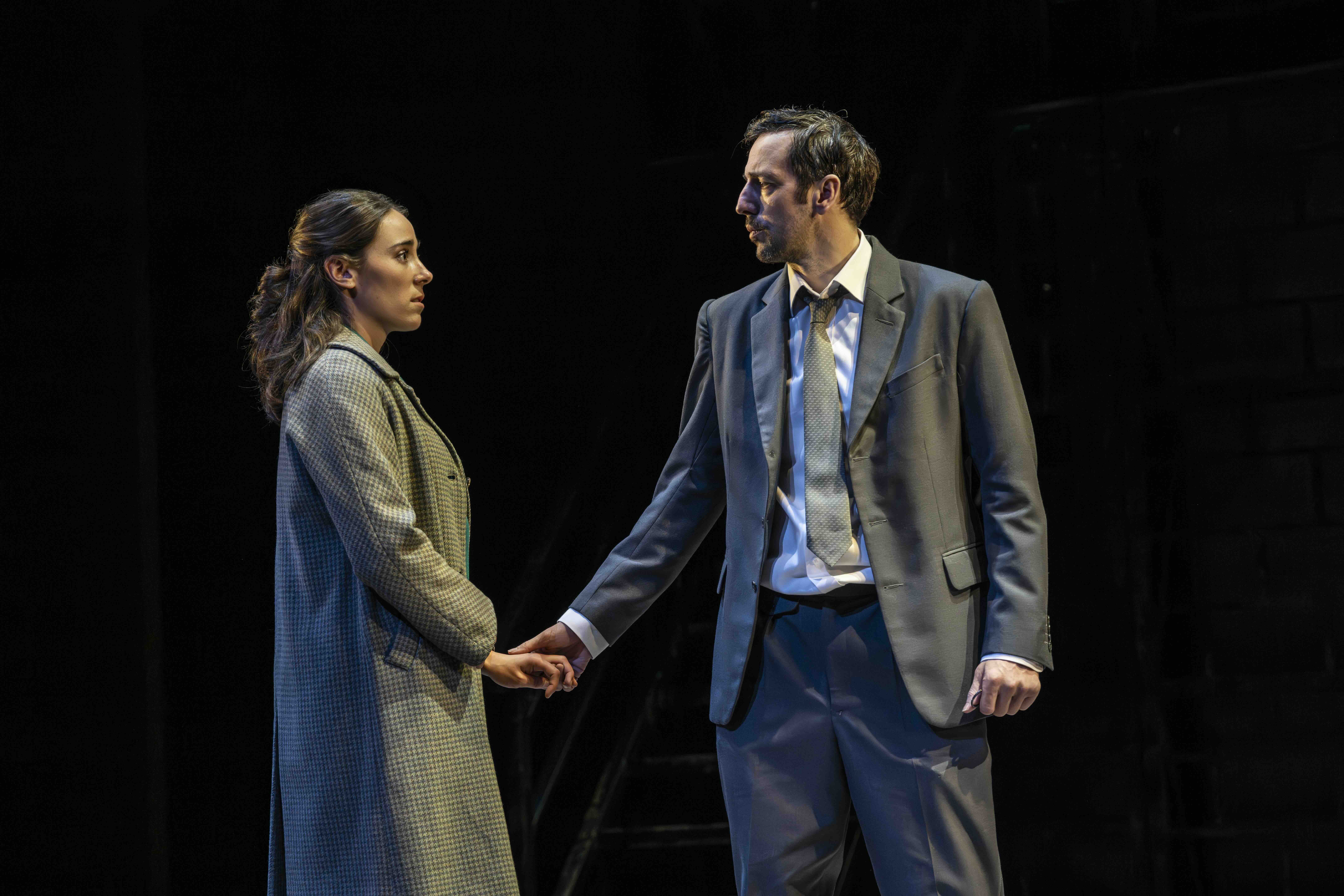
That unevenness carries into the performances. The production oscillates curiously between styles: at times, dialogue is delivered with a naturalistic ease; at others, it tips into something more oratorical, almost declamatory. The result is a lack of tonal cohesion, as if the cast are inhabiting slightly different versions of the same play. It’s not that the performances are weak across the board, there’s commitment here, but the production rarely settles into a rhythm that allows them to cohere.
At its centre, the figure of Alec Leamas should anchor the moral ambiguity of the entire narrative. Here, played by Ralf Little, though, he feels oddly insubstantial. The role demands a kind of much more weighted down, demoralised character, a man hollowed out by years of compromise and betrayal. Instead, there’s a sense of someone circling that depth rather than fully inhabiting it, which makes it harder to invest in the character’s final, devastating trajectory. Was this the direction or possibly the text or the way Little himself acted the role?
And then, perhaps tellingly, there’s the peculiar disorientation that crept in while watching. Somewhere along the line, the story became muddled in my head with Funeral in Berlin, that other Cold War tale, indelibly tied to Michael Caine, released a year after Richard Burton’s film of The Spy Who Came in from the Cold. The confusion lingered longer than it should have, leaving certain plot turns feeling strangely unfamiliar. It’s an odd admission, but also a revealing one: in a narrative that should grip with clarity and inevitability, moments instead felt curiously unmoored, as if the production itself wasn’t quite holding the threads tightly enough.
The first act is very slow despite some strong acting by Nicholas Murchie’s textbook upper class English Control, There are flashes where the piece gathers momentum, the tribunal scene, in particular, begins to generate the necessary urgency, but these arrive late, and don’t fully compensate for the languor that precedes them. It is possibly an intentional plot to have the actor who plays Smiley, Tony Turner, also playing the defence advocate. Probably unintended but Liz Gold, played by Gráinne Dromgoole, not only comes across as naïve but rather, well, plain stupid.
By the end, you’re left with an adaptation that gestures toward the bleak brilliance of le Carré’s world without ever quite capturing its suffocating intensity.
In the circus of British intelligence, where nothing is ever quite what it seems, this production offers intrigue, but at too great a distance to truly draw us in.
Until May 3
https://www.wmc.org.uk/en/whats-on/2026/the-spy-who-came-in-from-the-cold