Chapter Arts Centre
Even if, like this reviewer, you’ve never actually watched the television play Abigail’s Party in its entirety, its most famous moments have long since been absorbed into the national bloodstream. Alison Steadman’s Beverly, the creepy slow-dance crooning, the weaponised politeness, the cheese and onion on cocktail sticks, all loom so large that the play risks being mistaken for a nostalgic sketch rather than razor-sharp social anatomy.
Pam Wiener’s taught production for the Everyman Theatre, now playing at Chapter Arts Centre, briskly corrects that assumption. This is Mike Leigh’s Abigail’s Party not as heritage comedy but as still-functioning social satire: loud, excruciating, funny, and faintly alarming in how little has really changed despite this being firmly set in 1977.
Donna Summer is playing on the stereo while Beverly saunters around getting ready for her soiree, waiting for her workaholic estate agent husband Laurence to arrive home. New young neighbours Tony and Ang have been invited for drinks and nibbles, along with and Sue, the posher divorcee whose 15-year-old punk daughter (it is 1977), Abigail, is having a party.
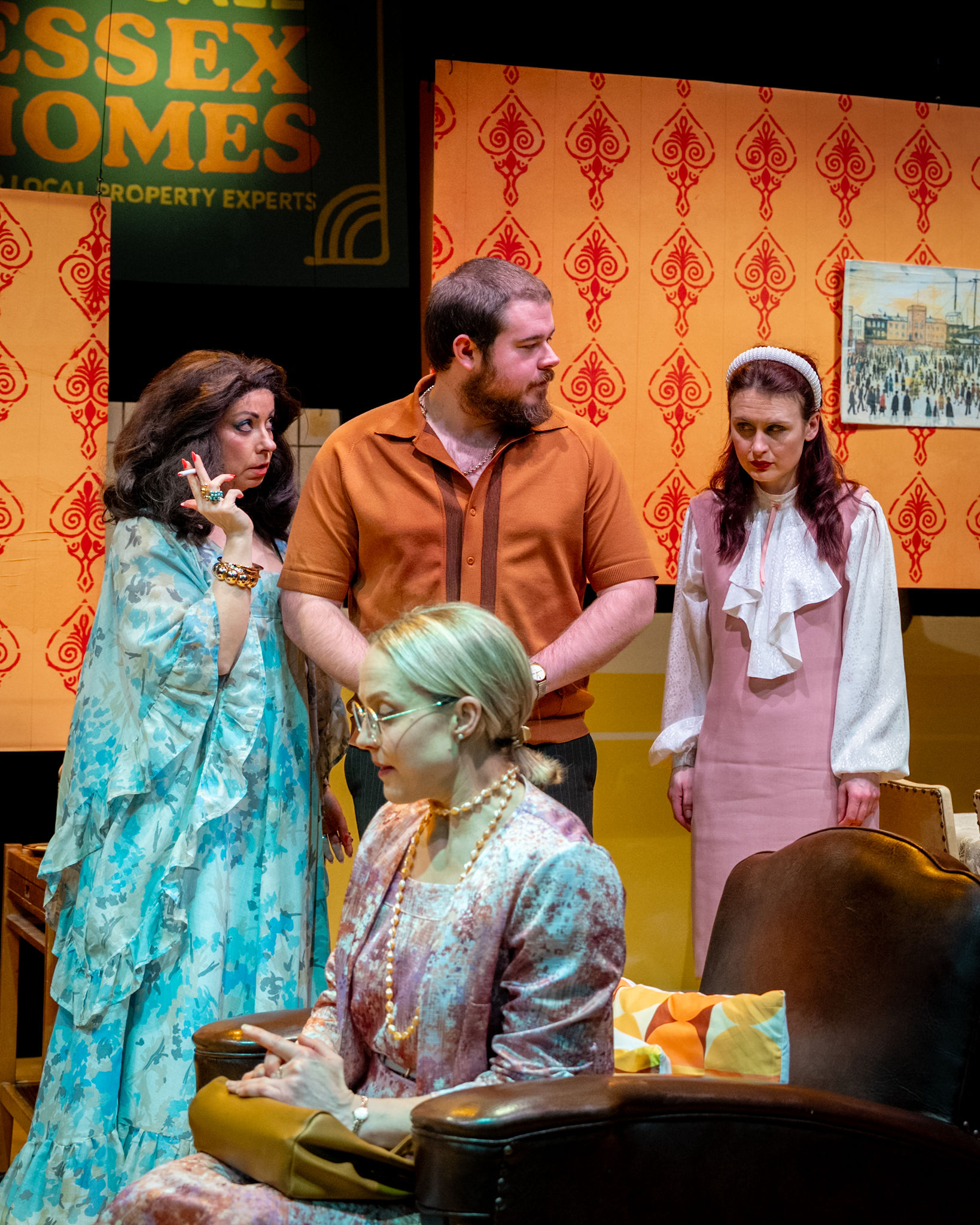
Sarah Whitefoot-Green, Jacob Langford, Elinor O’Leary, and front, Charlotte Ellen Price
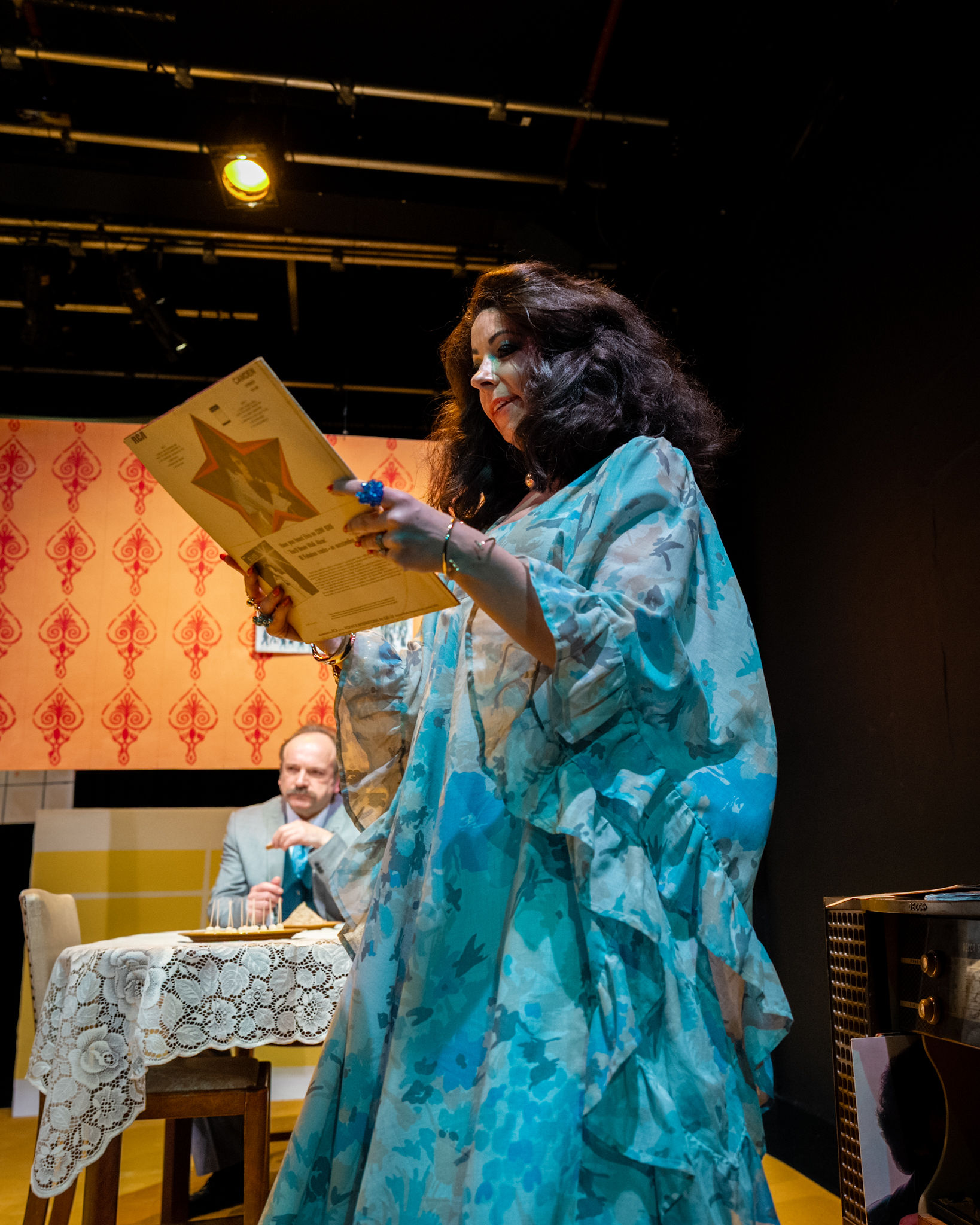
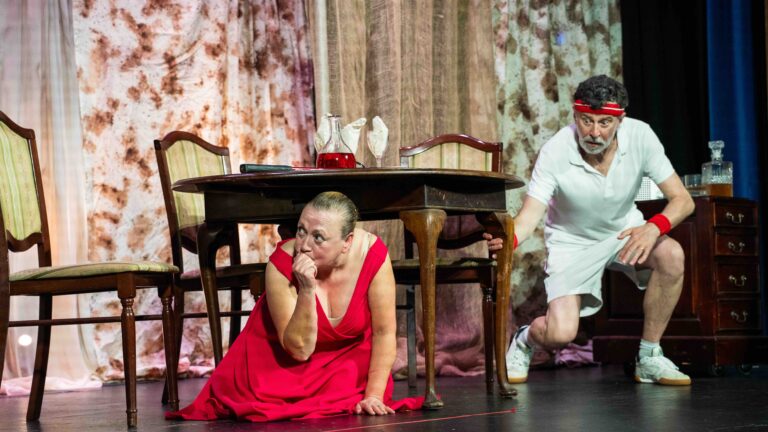
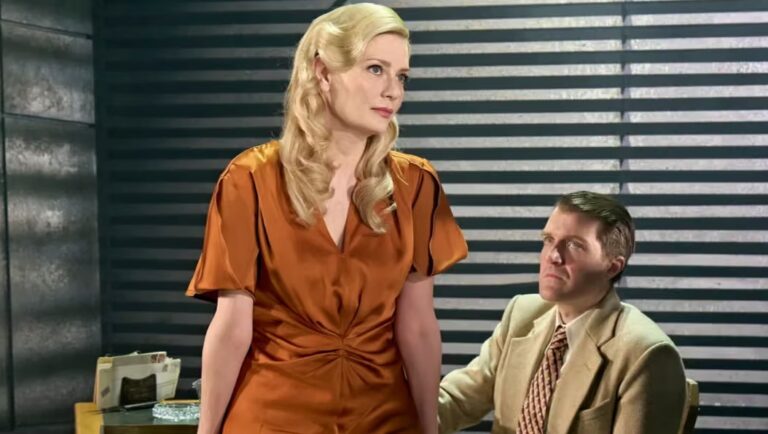
Toby Harris and Sarah Whitefoot-Green
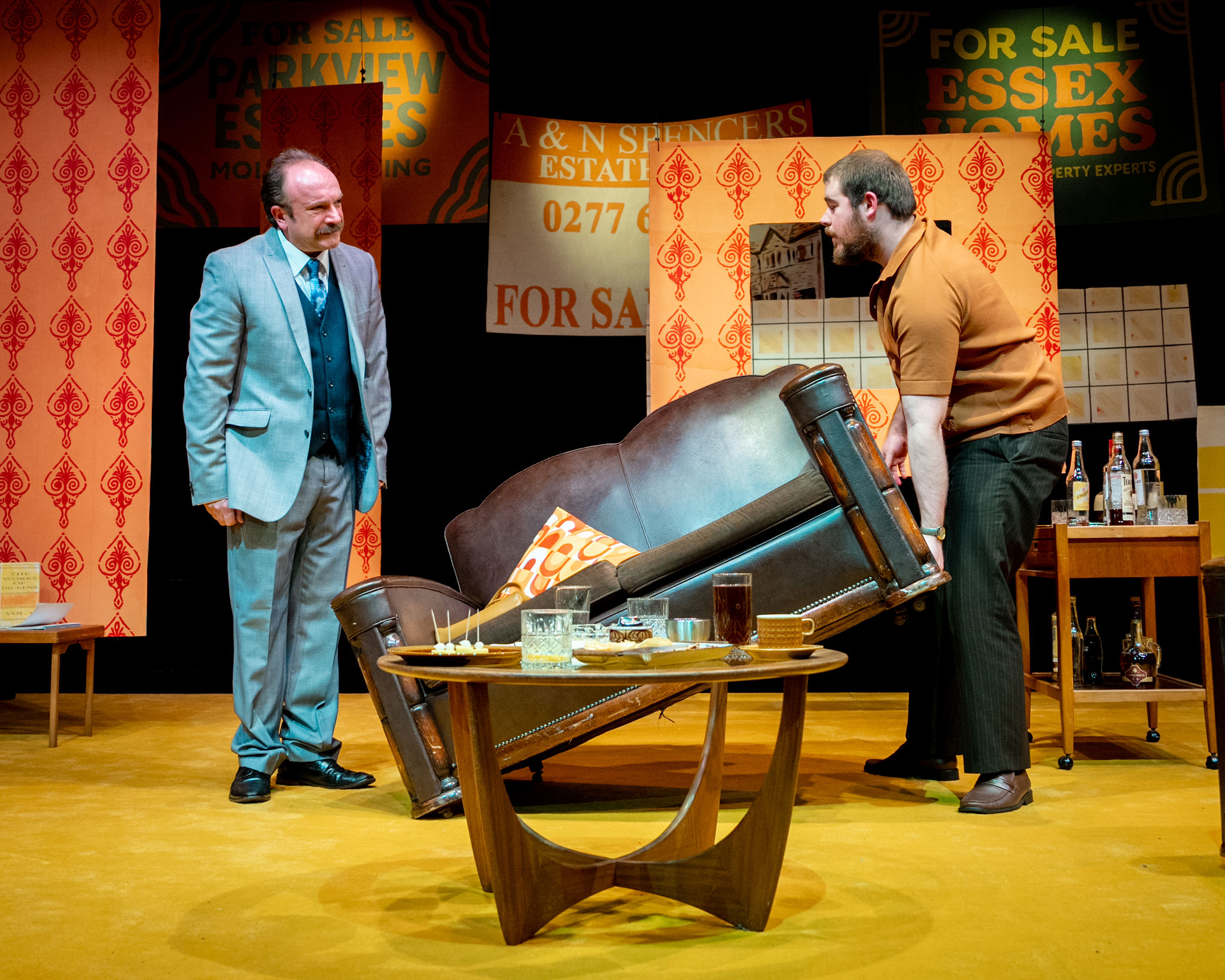
Toby Harris and Jacob Langford
Some of the accents are firmly Essex but the setting could be anywhere in suburban Britain. This is not, and never really was, “an Essex play”. It is a play about aspirational suburbia full stop. Cardiff, Crawley, Coventry: pick a housing estate where people care about status and where even an apparent love of culture is turned into a commodity and weaponised.
Entire legions of British comedy have followed in its wake, from Keeping Up Appearances through to Gavin and Stacey and Two Doors Down. That Alison Steadman herself pops up decades later as another suburban Essex matriarch in Gavin and Stacey only underlines the point: this is not a regional curiosity but a template. The awkward gathering, the brittle bonhomie, the passive aggression lubricated by alcohol.
House prices aside (Tony and Angela’s £21,000 home now belongs to fantasy fiction), everything else remains depressingly current. Work intrudes into leisure, competitiveness disguises itself as friendliness, and the drinks do not so much loosen inhibitions as flip a switch from repression to chaos. Above all, marriages crack under the strain of being publicly performed.
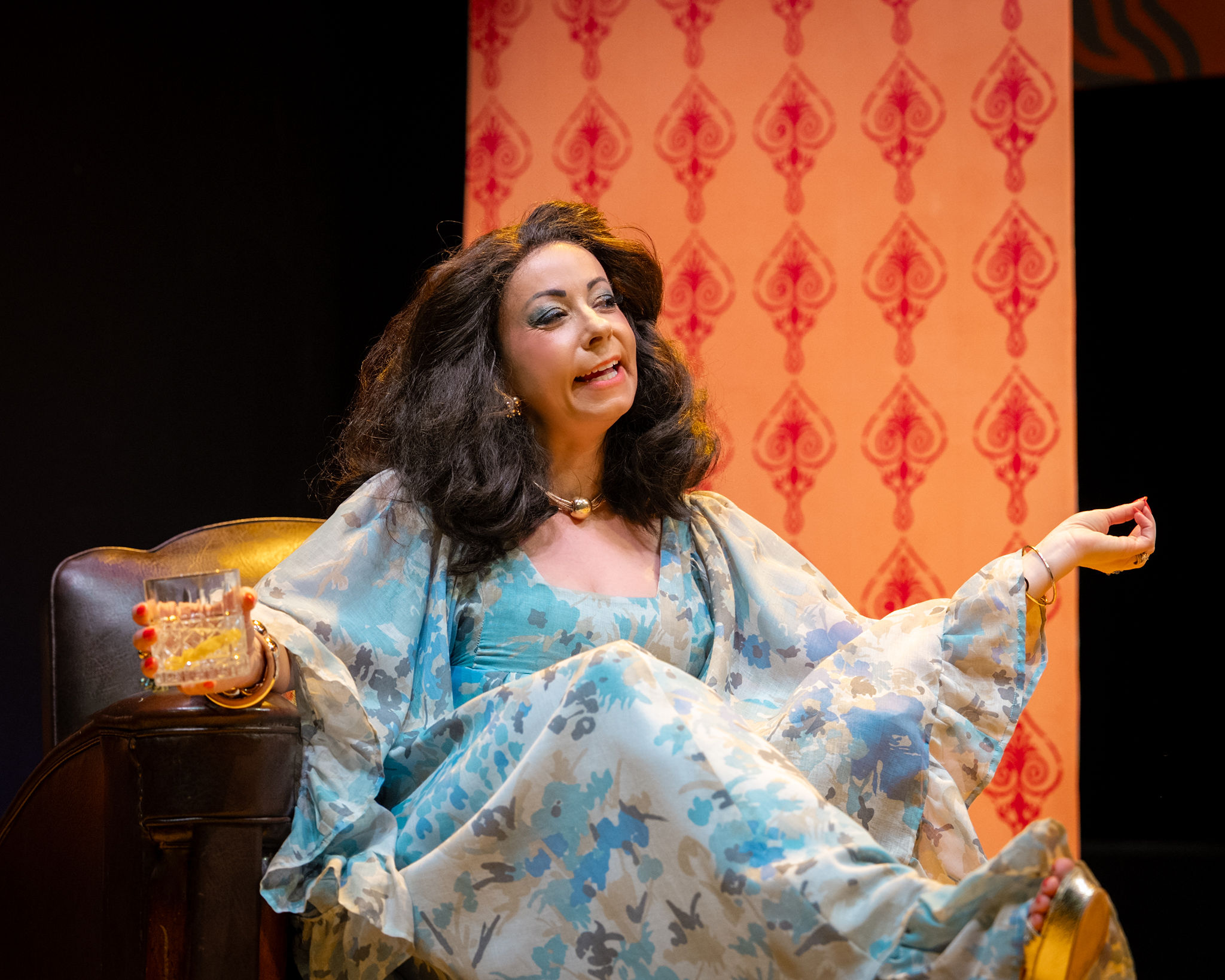
At the centre is Sarah Whitefoot-Green as Beverly, a hostess from hell rendered with glorious excess. Squeezed into a flowing floral dress, earrings flashing, hair in Farrah Fawcett-Majors waves and spraying Estee Lauder scent. She issues commands disguised as politeness and flirts with former footballer Tony with barely a fig leaf of restraint. Every “please” is loaded; every smile is a demand. Whitefoot-Green is perfect and most importantly makes the role her own.
She might be a monster but Whitefoot-Green gives us just enough vulnerability to stop Beverly becoming a complete villain. Even while needling her husband Laurence over the olives (“They’ve got a very bitter taste, haven’t they, Ang?”), she seems to be poking him in the hope of eliciting something, anything, resembling affection. Her infamous dance is hysterically funny, but also oddly sad: a sensuous woman flailing for validation in a domestic wasteland.
Toby Harris as Laurence is magnificently unbearable: portraying the man as sweatily uptight, emotionally parsimonious, clinging to control through irritation rather than authority. When his frustration finally tips into anger, even physical intimidation, it produces an audible ripple of shocked “oohs” from the audience, a reaction that is in itself revealing. He seems to value culture but is as shallow as his wife. The gold emboss work on the cover of his Dickens collected works is more important than the content. It mirrors Beverly’s silver-plated candelabra.
Clearly, some language and behaviour such as the men getting angry, jars with audiences. Yet throwaway rape jokes made by the women pass with silence. It would seem the sexual impropriety is played for humour so long as it’s female-driven. Male rage, by contrast, triggers immediate discomfort.
The supporting cast are uniformly strong. Elinor O’Leary as Angela is nervously upbeat to the point of collapse, while Jacob Langford’s Tony is so monosyllabic he appears to have opted out of language altogether. It is never really clear why Tony is so angry all the time with Angela. She is annoying but it is not clear why their relationship has so quickly soured. Susan, played splendidly by Charlotte Ellen Price, is the evening’s quiet tragedy, her unease sharpened by the offstage sounds of Abigail’s teenage party. The party is anarchic, carefree, and mercilessly alive, reminding them all that life is happening somewhere else.
The 1970s setting, complete with leather sofa and suburban bad taste, is lovingly realised, but it also gestures towards something bigger. Leigh’s original play emerged at a moment when neighbourhoods were shifting as new classes moved in, rubbing anxiously against older identities. Today, those transitions are more likely to be ethnic and cultural than purely class-based, but the underlying anxieties; about belonging, status, and who gets to define “respectable” behaviour remain strikingly similar. It is also a tale of boredom within relationships, sexual frustration, and gender expectations and disappointments. Change the surface codes and Abigail’s Party still functions perfectly.
This staging strips away any cosy nostalgia and reminds us why the play endures. The acting is superb and the direction flows faultlessly.
Chapter Arts Centre until January 31.
Main image: Sarah Whitefoot-Green



Great to see an intelligent thoughtful review- you wouldn’t get this in the local paper – and most observations are spot on !!!
Thank
Great review. Couldn’t agree more. It’s Elinor O’Leary not Elin, though.
Great to see an intelligent thoughtful review- you wouldn’t get this in the local paper – and most observations are spot on !!!
Thanks
Thanks you