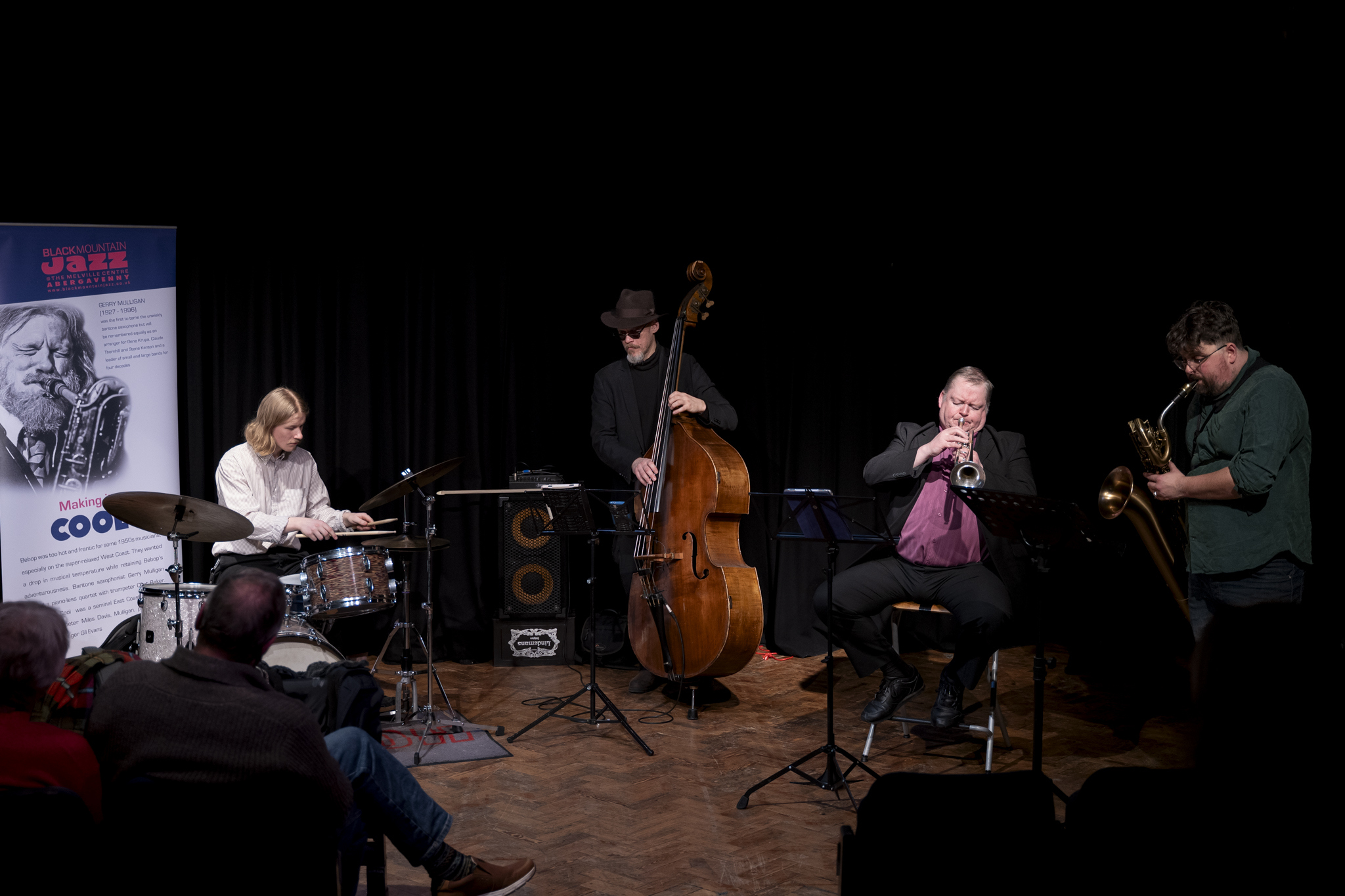
Black Mountain Jazz club’s piano was sidelined and partly hiding behind drapes at the start of its latest gig, which was wholly appropriate. The occasion was a tribute by the club’s collective house band and its guest, trumpeter Gethin Liddington, to the Gerry Mulligan Quartet. Renowned for its ‘cool’, West Coast sound in the 1950s, the American quartet’s most daring omission was the piano, a chordal instrument, which meant the foursome of drums, bass, baritone sax and trumpet had to be resourceful.
Mulligan, the baritone sax player, and Chet Baker, the trumpeter, were roles played on this occasion by the baritone player Jack McDougal (aka Jack Mac), and Liddington. The original drummer varied (Chico Hamilton, Larry Bunker, Dave Bailey), as did the bass player (Bobby Whitlock, Carson Smith, Henry Grimes) and, in later manifestations of Mulligan groups, valve trombonist Bob Brookmeyer replaced the trumpeter, and pianist Jimmy Rowles was included to confound the original concept of a piano-less band. Here, the drummer was Ryan Thrupp and the bass player Nick Kacal. It was a second Abergavenny appearance in succession for Kacal, who was a member of the Ross Hicks Trio at the last BMJ gig.
So, it was what the rock/pop fraternity call ‘a tribute band’. But, being a jazz tribute, that was only the nominal start of the story. Jazz’s homage to those who’ve gone before is not a simple act of mimicry, though there’s obviously an element of that in having to reproduce the inspirational sound. This quartet acknowledged the potential of such a combination of instruments; moreover, and with time to extend themselves rather than stick to the original clipped recordings of a few minutes, the exposure allowed each musician to demonstrate his singular qualities.
Like other ‘chamber music’ bands of the time, notably the Modern Jazz Quartet, the Mulligan group was so original in its pared-down instrumentation and sound that any homage would involve impersonation as not so much routine as inevitable. Without a piano (not an absentee in the MJQ), attention could be concentrated on the sax-trumpet lead. Baker and Mulligan did not always regard themselves as a duo playing the same harmonised or unison melody but explored its contrapuntal possibilities. Mac and Liddington took on this challenge in their own ways, and not literally note-for-note from the original, relatively brief takes. Also unlike those originals, Thrupp and Kacal added variety to their rhythm marking, the former’s tom-toms in My Funny Valentine and the latter’s double-stopping in Makin’ Whoopee typical of how, when there was no piano to fill space with spreading chords, there was time and room enough to make the performances interesting with other sounds. Makin’ Whoopee, incidentally, was played here much more exuberantly than the Mulligan quartet had, an example of how this tribute was keen to explore the Mulligan format’s potential, as they did in Kenny Dorham’s Blue Bossa. The Collective had been studying it earlier with the young musicians on BMJ’s Sunday jazz workshops, which precede the evening public appearances of the Collective with guests. Thrupp, especially, and Kacal were also featured in solos that would have been impossible to accommodate in the Mulligan quartet and, inevitably threatened here to dissolve the quartet’s tight cohesion; but that they were compulsive listening on their own account was indisputable.
Mac and Liddington had their own assertive approaches to leadership, Liddington’s silver trumpet betokening a bright tone before a note on it had been played, and Mac’s saxophone versatility – he usually plays tenor for Collective gigs but can access the instrument’s whole range – essential when calling up much more sax personality than the Mulligan quartet’s restrained approach permitted. He was certainly aware of the need to get the measure of Mulligan’s skill in making the unwieldy-looking bari a model of nuance and articulation. Liddington’s guest status was scintillating and heroic (he was nursing a chest infection), and his phrasing entertainingly varied in length, with the longer paragraphs as clear at the end as at the beginning and his brief visits to the stratosphere uninhibited by mellow Baker modesty. Mulligan wasn’t all uniformity, as indicated in Moonlight in Vermont, with its central episode considered on this occasion as a languid trumpet solo accompanied only by bass. Mulligan’s discography is prodigious, though Jersey Bounce and Love for Sale were played not so much as the Mulligan quartet played them but as charts to be tackled by a band with the Mulligan instrumentation. Only jazz musicians could interpret ‘tribute’ as such, and this gig demonstrated how well they do it in Wales.