Having already started exploring the catalogue of Benjamin Britten in a past season with a delicate, aesthetics-focussed rendition of Death in Venice, the WNO now tackles what is perhaps his darkest and most famous opera, Peter Grimes – a work so layered and so replete with difficult themes that the task of bringing it to the stage is inevitably full of pitfalls. All of these the WNO production, with director Melly Still at the helm, manages to avoid, resulting in what may well be one of the most powerful and most touching stagings they have offered in recent years. That, considering the constantly high quality delivered by the WNO in its post-lockdown seasons, is no mean feat, and it is very refreshing to see a mentality that keeps being centred on upping the ante rather than just resting on past glories. There are several gambles made in this production; all of them successful, and all of them fitting for a work that, by the very nature of its text, cannot be defanged or watered down without losing what makes it impactful.
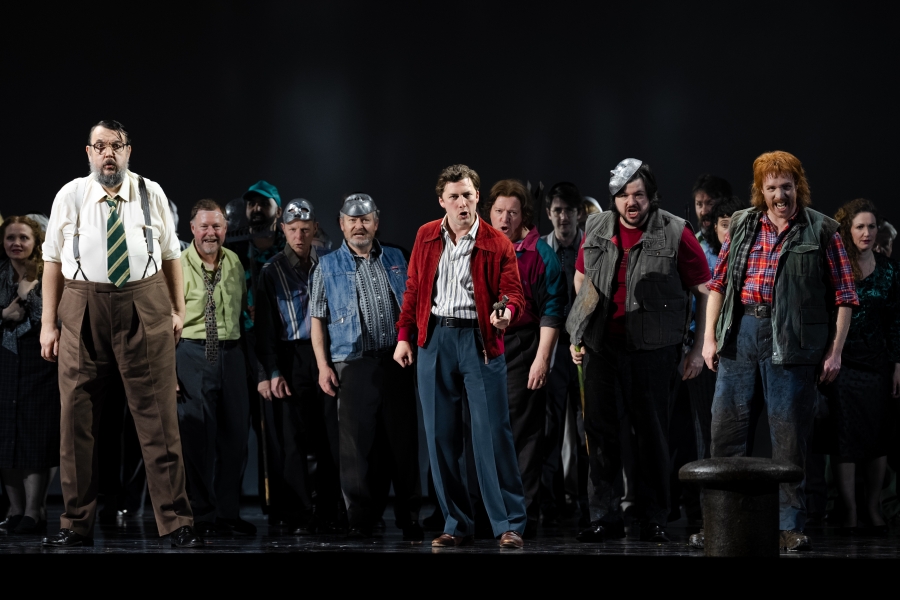
The cast of Peter Grimes
A sizeable part of the impact lies of course with Britten’s beautiful composition. The instrumental sections in this opera are especially gripping, full of a haunting beauty and in many ways telling the emotional story of the characters better than any words could. They need, and deserve, plenty of space to breathe and deliver their message, which cannot always be taken for granted in the performance of opera, an art form which has grown increasingly obsessed with the technicalities of voice, sometimes to the detriment of other aspects. Here the instrumentals are beautifully served by the WNO orchestra, led by Tomáš Hanus, and it feels correct to see the whole orchestra take the stage towards the end of the curtain call: they provide the backbone of a work in which the music is more than ever the narrator, summoning the constant murmur of the sea, the raging of the storm, and the turmoil of the main character’s soul.
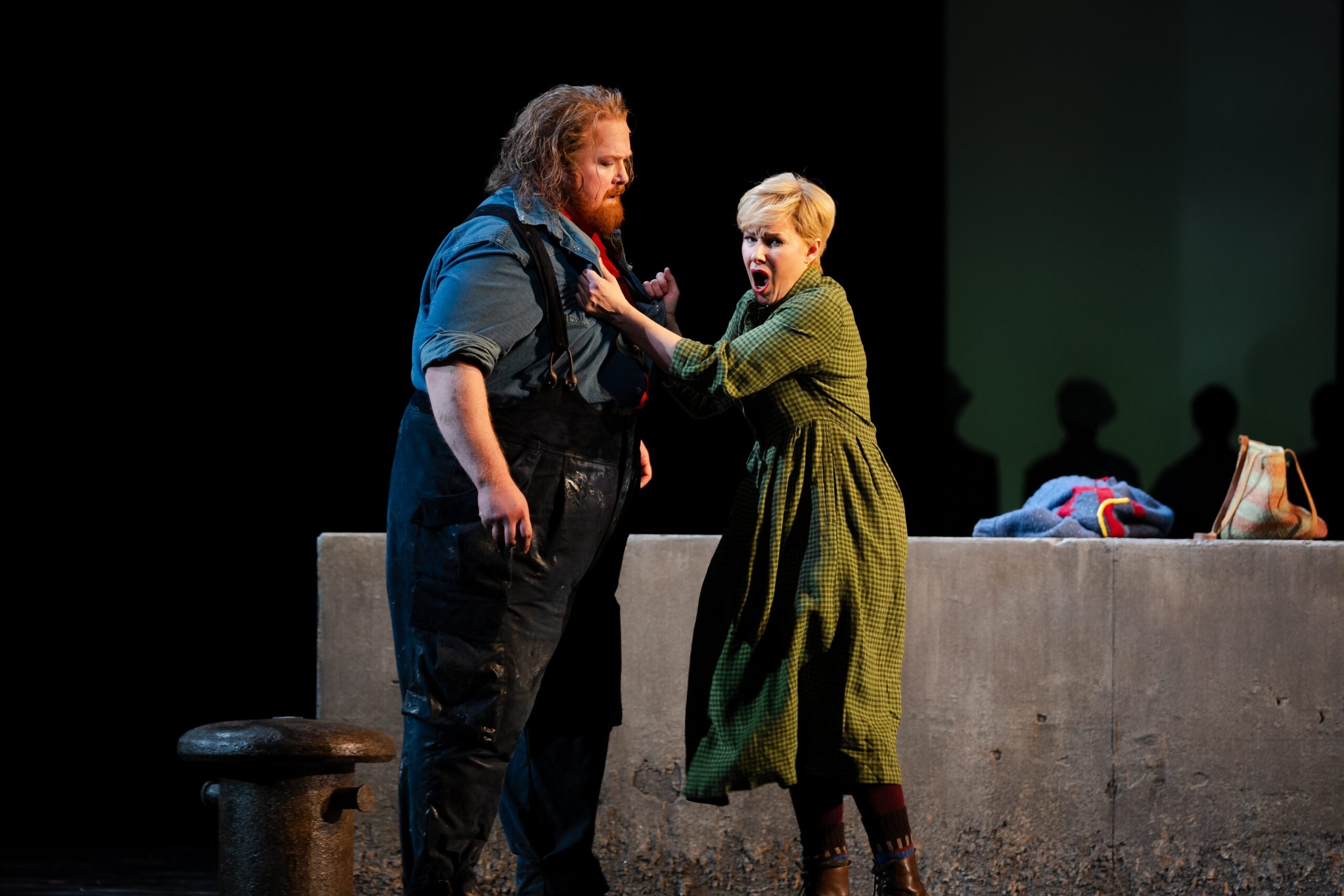
Nicky Spence and Sally Matthews
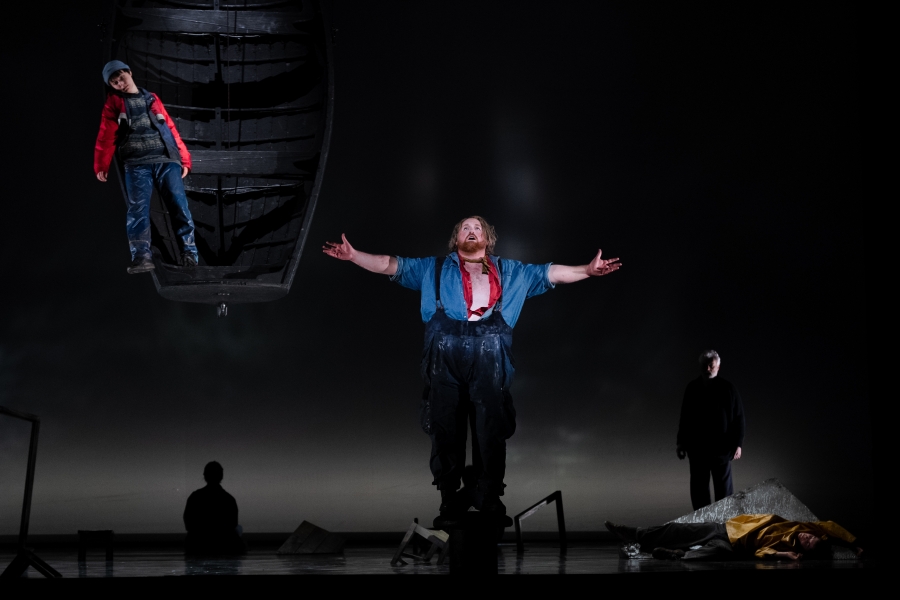
This is in part because, other than its eponymous anti-hero (expertly played by Nicky Spence, who tackles a texturally difficult part with technical grace and huge emotional sensitivity, managing to strike the complex balance between the character’s rough nature and the almost ethereal beauty of his solo sections), it could be argued that Peter Grimes has two other protagonists: the community of the Borough, which populates a number of crucial choral scenes, and the sea itself. The latter is embodied by the music, and in this production also by the staging, which chooses a stripped-down, less-is-better attitude to convey the stark reality of life in a fishing town and a colour palette which will feel familiar to anyone who has ever wintered by the coast. Having myself been born in a seaside town, I have often had occasion to notice how such towns are in a way always the same, regardless of geographical location: the sea, the wind, the storms shape not only the landscape, but also the mentality of the people, in a way that is very insightfully captured here. The spectre of death at sea is evoked from the very first scene, not only by the plot itself, but by what is possibly the most striking feature of the staging, the boat which hangs suspended, with its keel slowly revolving, throughout the first act, against a livid backdrop, like a reminder of the protagonist’s inevitable fate. For a moment towards the end of the act, when Grimes dares to dream of a new beginning, the inside of the boat is lit up with stars – but when it reappears towards the end of the third act, when all is said and done and doom inevitable, it is empty again, with its ribbing exposed like bones, and looking ever more like a presage of death.
Nicky Spence
There is something reminiscent of Moby Dick in Peter Grimes, and this boat that is also a coffin makes the connection feel closer, exposing all the other links as well: the story of a stubborn seaman whose chase of an impossible dream leads him, and those close to him, to an inevitable doom; the juxtaposition between the raging sea and the hymns being chanted in the Sunday service; the dream of wealth offered by the sea intertwined with the shadow of death. Blending together suggestions from folk music and sea shanties, religious composition and post-modern sensitivities, Britten’s music brings all these elements to life, and the staging works excellently in complementing it.
As for the other protagonist – the community, or it would perhaps better to say the crowd – all of these characters are certainly morally grey, and all of them could be argued to be to some extent hypocrites; it is therefore fitting that they are represented by a series of nuanced and considered performances. David Kempster is a stand-out as Captain Balstrode, whose apparent empathy is laced with something pitiless; Oliver Johnston is brash and always vaguely threatening as Bob Boles; Catherine Wyn-Rogers’ Mrs Sedley brings a touch of humour but also manages to become a sinister focal point of the final turning of the tide; Dame Sarah Connolly is compelling as ever as Auntie, the pub landlady, one of the most multifaceted characters in this opera. Perhaps the hardest job falls to Sally Matthews, who has to delve into some very complex emotional depths in his representation of Ellen Orford, and infuses her delivery in turn with care and despair. Praise must be given also to the dancers, who bring an essential piece to the puzzle of a narrative that can only be collective.
The theme of mob mentality is inevitably present in the letter of the text; this staging of Peter Grimes makes it all the more contemporary by the way it chooses to bring it to life. It is hard not to notice that Grimes is considerably more guilty at the end of the opera than he was at the start, and that he has become so precisely as a result of his effort to escape the pressure of the crowd which branded him guilty in the first place. It would be way too naïve to turn this into a lesson about the evils of undiluted cancel culture, but it is also very hard not to make the association. What Britten’s portrait of the Borough tells us, ultimately, is that there are no saints, and there are no demons: there are humans, full of contradictions and as mutable as the sea. To mark someone out as a villain is perhaps to create a villain – and in such a proposition there is no positive outcome possible for anyone.
https://wno.org.uk/whats-on/petergrimes
Images Dafydd Owen