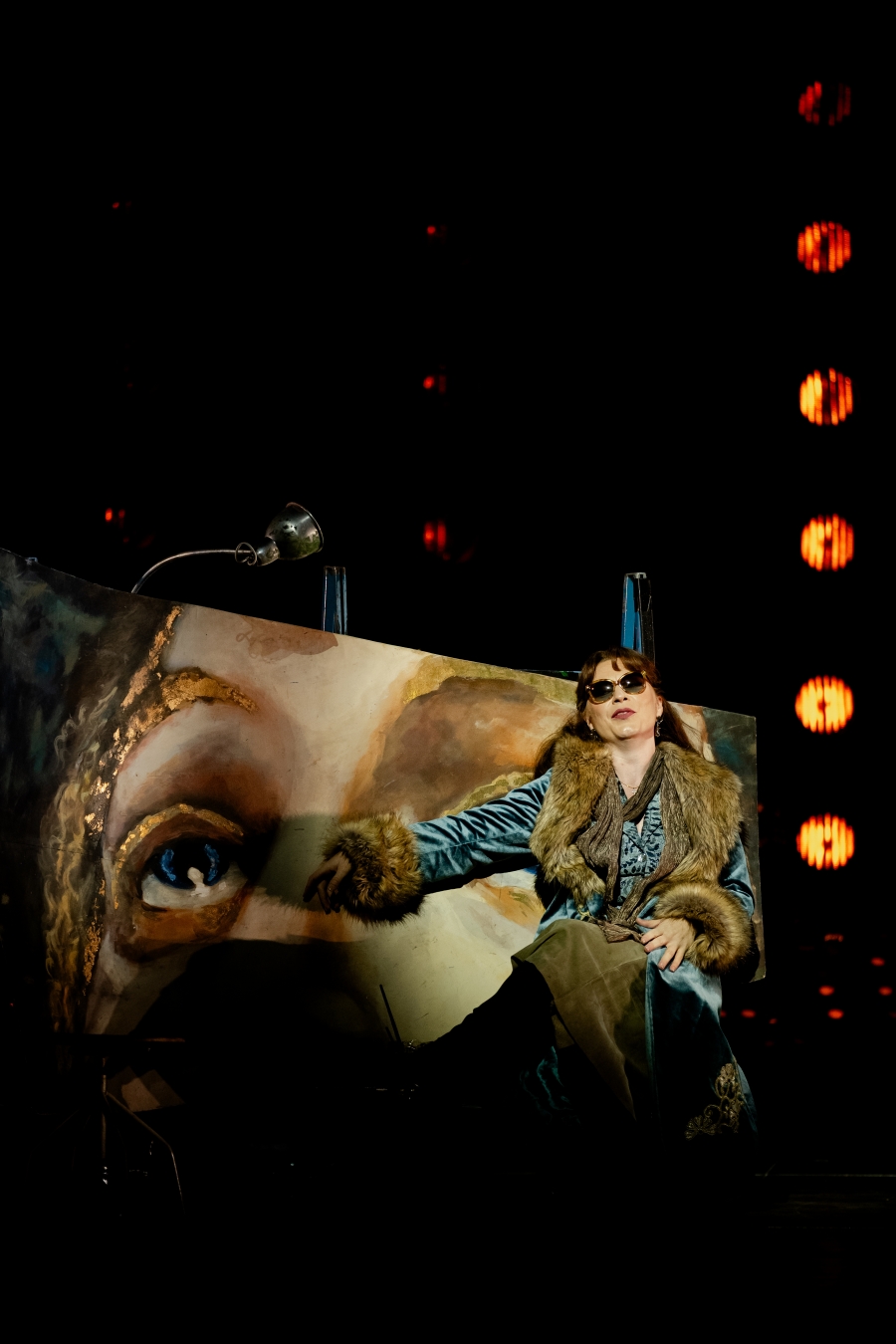
Welsh National Opera inaugurated its Autumn season – aptly accompanied by very turbulent autumnal weather – by bringing back to the stage the great opera classic that is Puccini’s Tosca. This is one of those operas that can feel rather daunting to approach: not only because of its well-deserved fame, but also because its plot is so linear and stripped-down, and its characters so human and complex, that it is entirely the exploration of the latter that carries the success of a production, even beyond the level of the vocal performances. The WNO had last revisited to great effect in 2018, an excellent outing which saw Claire Rutter in the title role. It now comes back to the Millennium Centre stage with a new aesthetic with set designs by Tom Scutt, under the direction of Edward Dick and with Natalya Romaniw as the tragic singer. The overall feeling of the production is solemn in places and stark in others; once again the WNO shows equal attention to the acting and to the vocal performances, which is very welcome considering a lingering reluctance to fully invest in the acting element when it comes to opera. Here, more than anywhere else, the quality of the acting is essential to the delivery of the performance as a whole. The orchestra is led by Gergely Madaras for this occasion, and delivers as beautifully as ever.
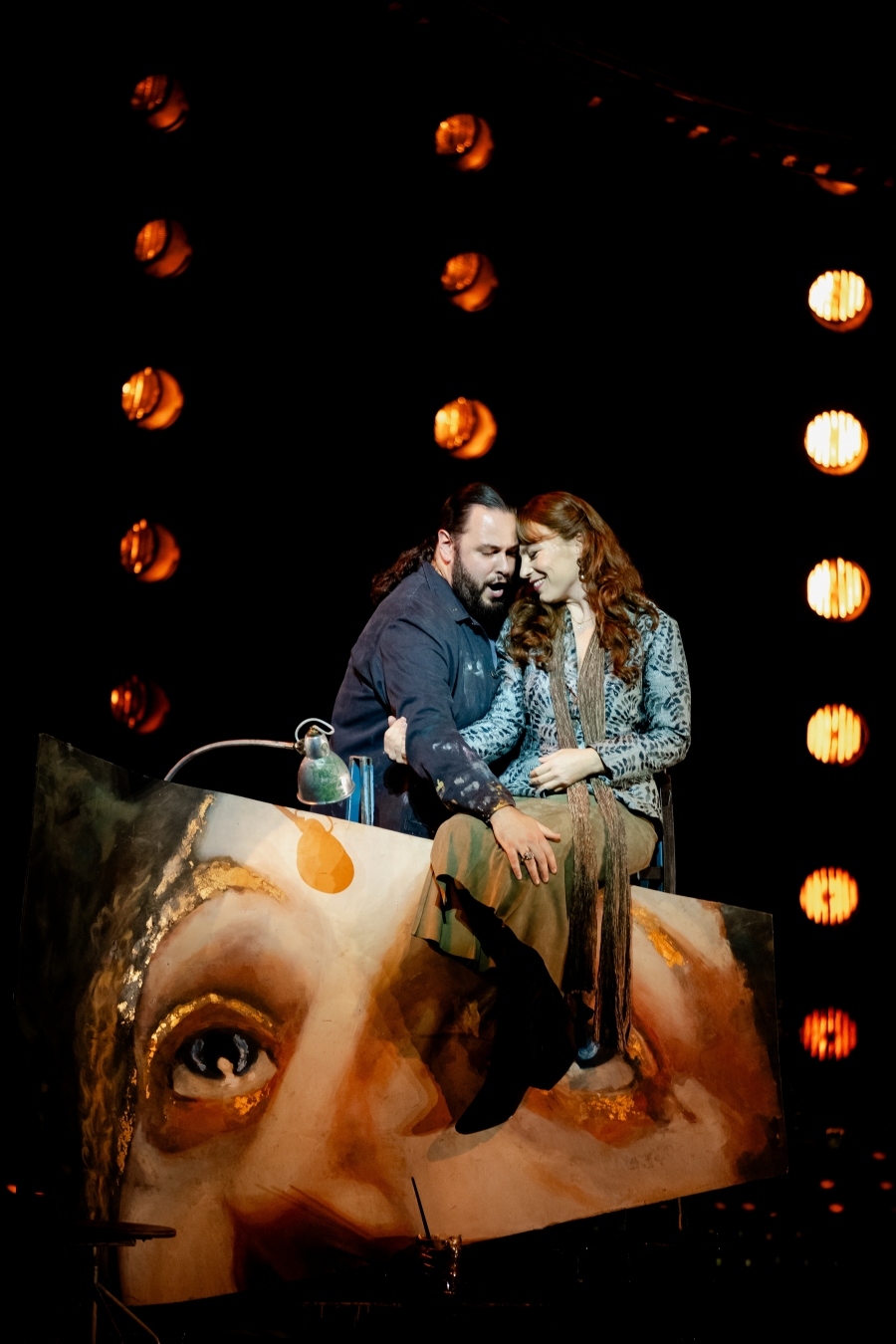
Andrés Presno and Natalya Romaniw
Also a constant with WNO productions, the sets are beautiful: these are minimalist in places, dominated by the almost haunting painted cupola which moves from act to act, a vessel symbolising different things in turn – Cavaradossi’s art, the ever-present eye of the divine watching all that unfolds during the second act, and finally the fateful opening through which Tosca falls to her death. The choice to give the production a modern flavour, on the other hand, leads to somewhat mixed results. The story of Tosca is a very time-specific one: it truly makes full sense only in the specific historical context Puccini placed it in, which is why most productions tend to be fairly conservative in this respect. Its story of Catholic hypocrisy needs the framework of the Pope’s Rome to land its blows as heavily as it should. Its sinister villain, Baron Scarpia, is not merely the enforcer of an authoritarian power, but of a religious one specifically, and it is in that tension that his character comes through fully rounded. By placing the story in a more modern context, parts of this thematic red thread are inevitably lost: Scarpia comes across as a more banal kind of sexual predator, the rebellion of Angelotti and Cavaradossi appears aimed at an established power rather than at a whole way of thinking. There are moments in which this original tension still emerges clearly – never as strongly than during the Te Deum sequence, which still feels powerful – but there are also others in which it feels rather dampened, like something has gone missing with the loss of the original setting.
Not that the production lacks moments of intensity and beauty. Its protagonists deliver well-rounded and thoughtful performances, the stand-out among which is offered by tenor Andrés Presno as Cavaradossi: vocally strong and technically precise throughout, he shines especially, as was to be expected, during his delivery of the famous aria E Lucevan Le Stelle, which is crisp and emotional at the same time, a true high point of this whole production which was welcomed, and rightly so, with thunderous applause by the audience. Romaniw as Tosca she is perhaps a little overly emphatic on Vissi D’Arte, Vissi D’Amore, but manages the tragic crescendo at the end of the final act very well, and her performance in the scene of the death of Scarpia is careful and filled with clever little touches. Dario Solari as Scarpia gives a strong performance from the vocal point of view, capable and well-rounded; his delivery of the character is somewhat hampered, as noted, by the modern setting, especially in the second act, where he steps out of the religious context and into the private one, but this does not prevent him from feeling genuinely threatening throughout. Further credit is to be given to Alun Rhys-Jenkins’ scurrying Spoletta, to James Cleverton’s rather forceful Angelotti (who, at the very beginning, climbs onto the stage down a rope through the eye of the painted dome, almost Mission Impossible-style), and to Ross Fettes’ tongue-in-cheek Sacristan: all three performances well-considered and nuanced, adding important shades to the production as a whole.

Andrés Presno and Dario Solari
The overall feeling is of a competent Tosca which couples moments of brilliance and genuine emotional peaks with sections in which it may feel like the staging is working to some extent against the performers. Nonetheless a strong opener to the new WNO season, confirming it as one of the hearts of opera excellence in the UK. There is a clear love of the craft and an equally clear desire to make these works speak to as broad an audience as possible in everything the WNO brings to stage that is to be even more deeply commended at a time when opera far too often is unjustly painted as obsolete.
Wales Millennium Centre until September 27 and touring until October 18, including Venue Cymru, Llandudno, October 11.
https://wno.org.uk/whats-on/tosca
Images: Dafydd Owen
Also this season:
Why not actually name the designers, when talking about the design concept? It’s quite insulting, isn’t it.
added