***
There was something slightly surreal about watching a nearly 30-year-old David Pountney production of Simon Boccanegra at Grange Park Opera, with props from his latest work for the festival — his brooding new staging of Tchaikovsky’s Mazeppa—sitting off to the side of the theatre in the woods.
As a collision of old and new, it was a reminder of Pountney’s remarkable longevity on the British operatic scene. This Simon Boccanegra, first staged for Welsh National Opera in 1997 before Pountney became the company’s artistic director, has survived the years with surprising vigour.

Elin Pritchard and Otar Jorjikia
Though revived by Robin Tebbutt, it was interesting to note that the original director was in attendance at some of the performances — presumably because Mazeppa, Pountney’s latest offering, is also part of this season’s repertoire at Grange Park. A neat full-circle moment for a director whose visual imagination still shapes this company’s stage.
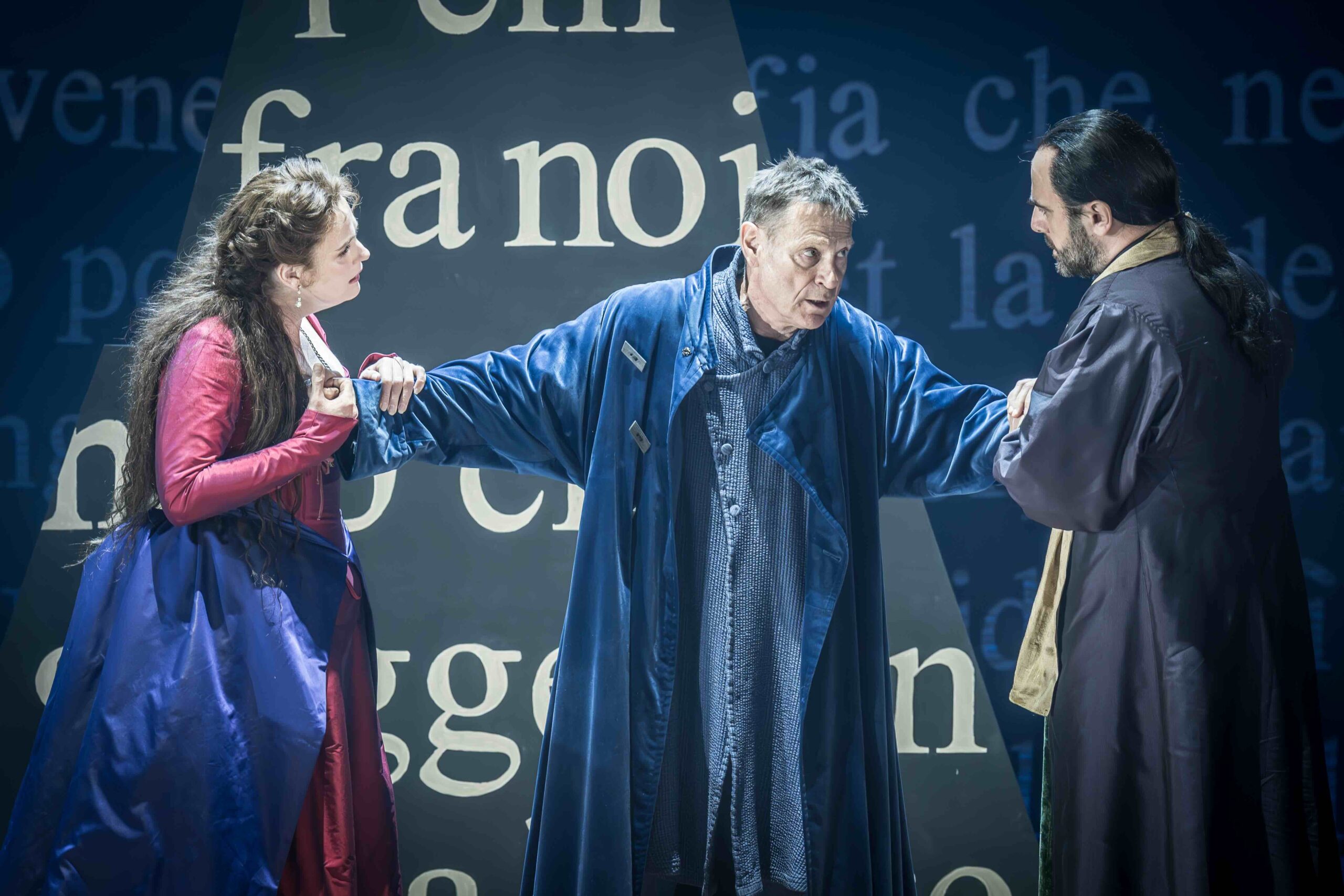
The production remains stark, emblematic, and theatrically poised—Verdi refracted through a lens of high-concept minimalism. Two vast hanging screens create spaces and convey moods and atmospheres. But while the aesthetic held its ground, it was the voice of Elin Pritchard, singing Amelia Grimaldi, that lifted this performance into something altogether more luminous.
The Welsh soprano who has sometimes been overlooked despite her considerable vocal and dramatic gifts, emerged here as the revelation of the evening. In a score teeming with Verdi’s complex male relationships and heavy lower voices, she became the heart of the piece. Her soprano is warm, pliant, and unforced, with soaring top notes and a middle register rich with lyrical nuance. She brought Amelia vividly to life: not merely a plot device in the opera’s notoriously labyrinthine story, but a real, emotionally charged figure, torn between loyalty, love and fear.
She was at her best in the recognition duet with Keenlyside, shaping each phrase with care and conviction, her voice blooming into the theatre’s acoustic with thrilling clarity. In Act II, opposite Otar Jorjikia’s impassioned Adorno, her singing glowed with pathos and intensity. At the curtain call, the ovation she received was long, loud, and richly deserved—the audience knew they had witnessed something special.
Sir Simon Keenlyside, no stranger to this repertoire, brought his signature intelligence and emotional depth to the title role. Welsh National Opera was one of the companies where he first cut his operatic teeth, and he had been scheduled to return there this year in Rigoletto—until the company’s financial crisis forced the cancellation of the production. In this context, his presence here carried a certain charge. He has a natural dramatic instinct that is always razor-sharp with a baritone that is exceptionally expressiveness. Whether conveying tender vulnerability or commanding authority, his singing is always deeply felt. Keenlyside’s precise diction and sharp dramatic instincts make every phrase resonate, turning each line into a finely wrought moment of theatre.
A dignified James Creswell was sonorous and imposing as the implacable Fiesco, and Jorjikia delivered Adorno’s passionate lines with muscular, heroic tone.
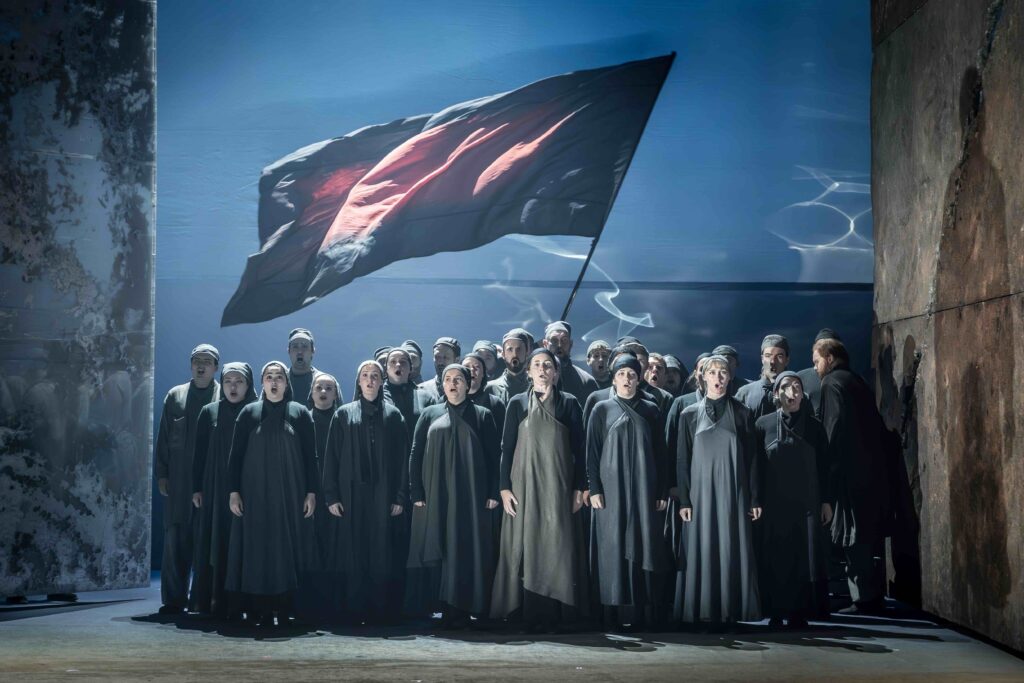
Pountney’s stage pictures still pack a visual punch. The monumental panels—one resembling a jagged cliff, the other a tarnished metallic screen—shift to reframe the action, illuminated evocatively by Tim Mitchell’s painterly lighting. Sue Willmington’s costumes give warmth and richness to an otherwise austere stage, while Amelia dazzles in shimmering green and then vibrant red and blue silks.
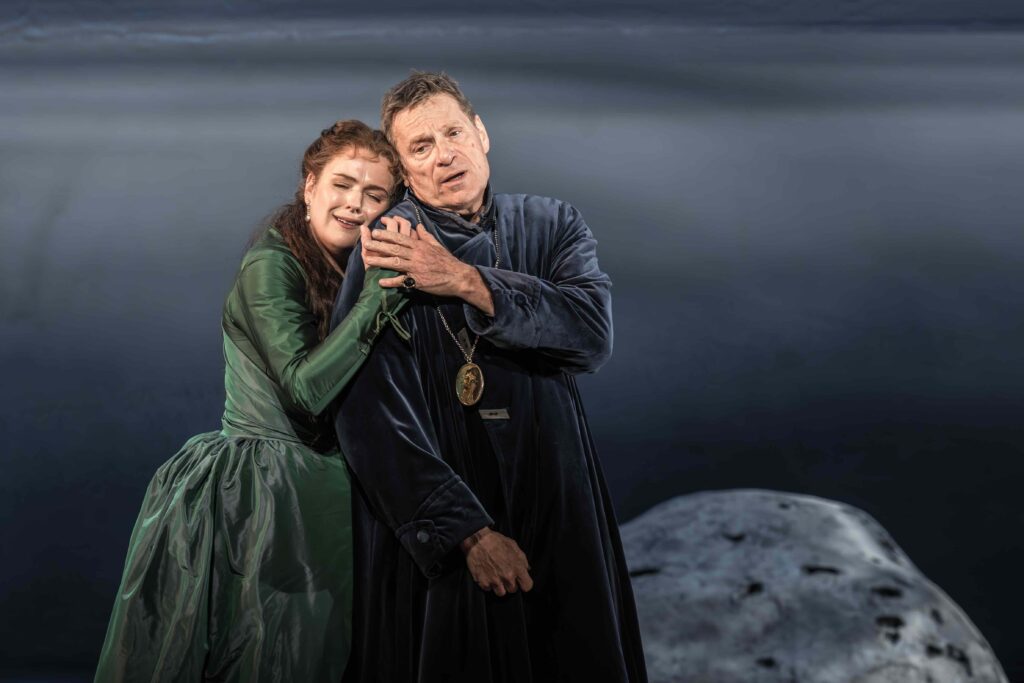
Elin Pritchard and Simon Keenlyside
There are moments of vintage Pountney: Maria’s body ascending heavenward, her shroud caught symbolically by her daughter; the (limited number of) Patricians towering on stilts in the Council Chamber; Petrarch’s Canzone 128 scrawled on the walls in Act III. These images allwork—but it is Keenlyside’s dramatic interpretation and Pritchard’s emotional truth that gives the evening its pulse.
Conductor Gianluca Marcianò led with vitality and sweep, drawing luminous colours from the orchestra and shaping Verdi’s difficult architecture with assurance, and the Grange Park Chorus, in fine voice.
Simon Boccanegra may not be the easiest Verdi to love—but this revival, anchored by Elin Pritchard’s radiant performance, made a persuasive and deeply moving case for it.
Main image: Elin Pritchard, Simon Keenlyside and Otar Jorjikia