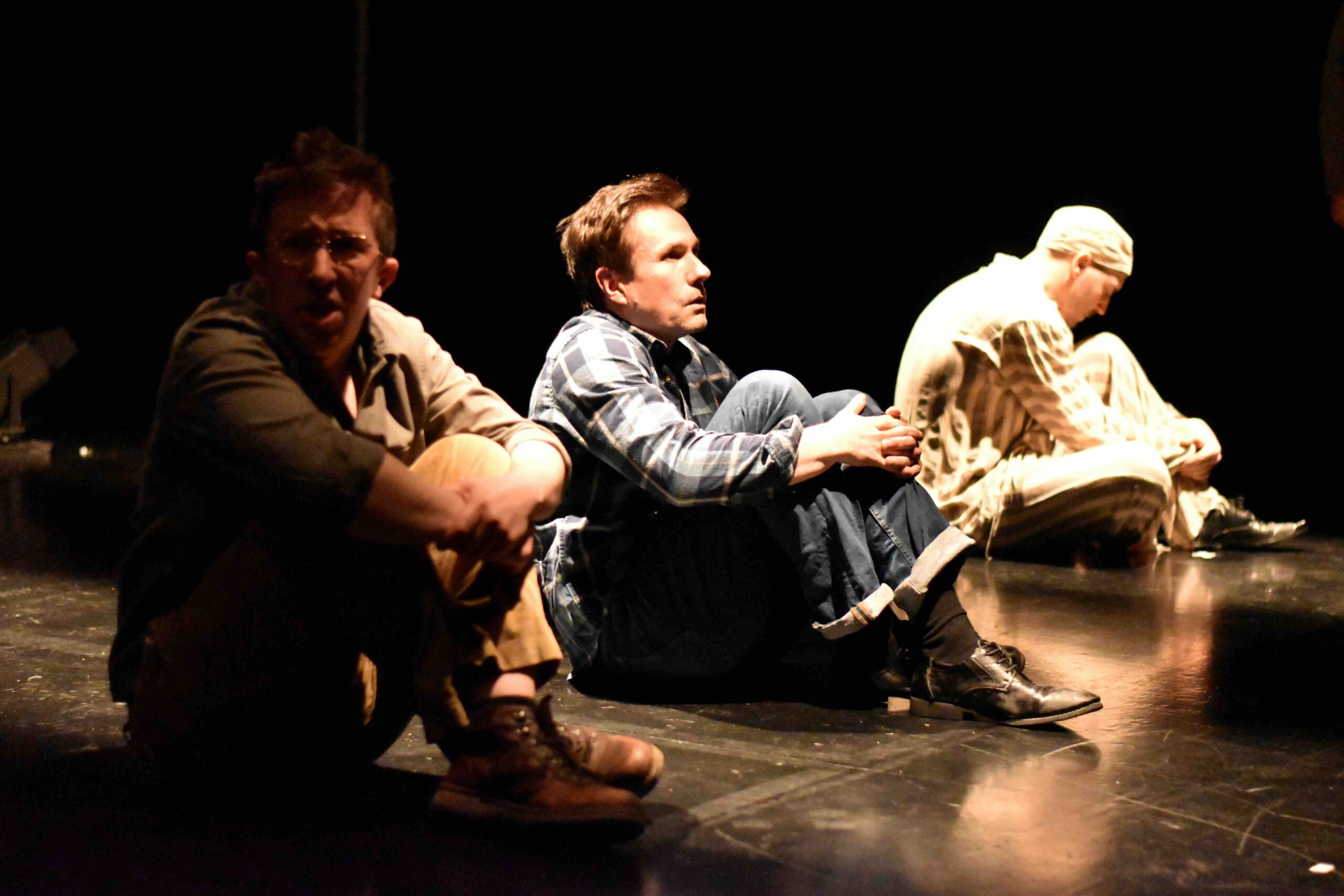
The latest production from Everyman Theatre Cardiff at the intimate Seligman Theatre at Chapter Arts Centre is a reminder that powerful theatre does not depend on scale, elaborate staging or large budgets. Their staging of Bent is a strikingly effective piece of drama: emotionally intense, imaginatively staged and anchored by performances that would not feel out of place on a large scale stage.
Martin Sherman’s play remains one of the most uncompromising theatrical explorations of the Nazi persecution of homosexual men. Moving from the decadent nightlife of 1930s Berlin into the brutal reality of the concentration camps, Bent traces the moral and emotional journey of Max, a man whose instinct for survival leads him first to deny who he is before confronting the devastating cost of that denial.
At the centre of this production is a remarkable performance by Steven Smith as Max. Smith delivers a portrayal of impressive emotional range, charting the character’s transformation from cynical opportunism to painful moral awakening. Early in the play his Max is evasive, restless and driven by self-preservation. Faced with the growing menace of Nazism, he attempts to distance himself from danger in whatever way he can.

Dan Thomas
Sherman’s script does not shy away from the uncomfortable realities of this instinct to survive, and this production wisely leans into that complexity. The play confronts the ways in which some gay men attempted to protect themselves by denying or concealing their sexuality, and Smith’s Max embodies that fear-driven strategy with unsettling clarity. At several moments he tries to insist that he is not homosexual, grasping at any identity that might keep him alive. It is a painful but honest portrayal of survival under totalitarian terror.
Equally striking is the play’s refusal to present its characters as morally uncomplicated victims. In the early Berlin scenes, the gay characters themselves speak dismissively and even insultingly about Jews, reflecting a social hierarchy of prejudice that existed long before the full horror of Nazi persecution engulfed them as well. These moments land with particular force because they reveal how discrimination can exist even among those who will soon become targets themselves. The production handles these exchanges without softening them, allowing the audience to confront the uncomfortable truth that fear and prejudice often coexist.
The early scenes are defined by Max’s relationship with Rudy, played with sensitivity by Owain Miller. Miller’s Rudy, a dancer whose flamboyance places him directly in the Nazis’ sights, provides an effective emotional counterpoint to Max’s wary pragmatism. The balance between the two performers works particularly well: Rudy’s openness and vulnerability contrast sharply with Max’s attempts at emotional distance and self-protection.
This contrast becomes painfully significant when Rudy is targeted by the authorities and Max, in an act of desperate self-preservation, denies knowing him. The moment lands with devastating force precisely because the chemistry between Smith and Miller has already established a believable relationship. Miller’s performance captures Rudy’s vulnerability with quiet dignity, making the betrayal all the more tragic.
The emotional centre of the production, however, lies in the relationship that develops later in the camp between Max and Horst. Here Dan Thomas delivers a deeply moving performance as the prisoner who ultimately forces Max to confront both his identity and his humanity.
Horst, marked by the pink triangle worn by homosexual prisoners, refuses the strategy of denial that Max initially adopts. Thomas plays the role with calm conviction and warmth, creating a character whose quiet strength becomes the moral anchor of the play. The scenes between Thomas and Smith are among the most powerful in the production.
Their relationship unfolds during the gruelling camp sequences in which the prisoners are forced to carry stones from one place to another and back again in a cycle of meaningless labour. In this production the task is represented by broken chairs, an inspired piece of minimalist staging that captures both the absurdity and cruelty of the punishment.
As Max and Horst move these objects back and forth across the stage, their conversations gradually deepen, forming a fragile emotional connection within the brutal environment of the camp. The intimacy of the Seligman Theatre makes these scenes especially affecting. With little physical distance between performers and audience, the quiet exchanges between Smith and Thomas carry extraordinary emotional intensity. By the time the relationship blossoms into love, it feels entirely earned.
The production begins with a memorable theatrical flourish. The opening drag aria performed by Paul Fanning as the cynical Greta immediately establishes the decadent Berlin nightlife from which the story emerges. Fanning’s performance is flamboyant yet edged with weary irony, capturing the brittle glamour of a world that senses danger approaching but refuses to acknowledge it fully.
Visually, the production is impressively economical. The set design embraces simplicity rather than attempting elaborate historical realism. The broken chairs and suitcases used to represent the camp’s stones become the dominant visual motif, suggesting fragmentation and dehumanisation while also serving the practical needs of the staging.
Lighting plays an equally important role in shaping the production. Within the spatial constraints of the Seligman Theatre, carefully designed lighting shifts create distinct locations and moods, moving the audience from Berlin’s shadowy nightlife to the stark brutality of the concentration camp with remarkable fluidity.
What is perhaps most striking about this production is how the performances are disciplined, the pacing assured and the staging imaginative. Watching the play unfold, it becomes easy to forget that this is not a fully resourced professional company.
With Steven Smith’s powerful central performance, the moving partnership between Smith and Dan Thomas, the poignant presence of Owain Miller’s Rudy and the vivid opening turn from Paul Fanning as Greta, Everyman Theatre Cardiff has created a production of Bent that is both emotionally devastating and theatrically intelligent.
One leaves the theatre reflecting not only on the horrors depicted on stage but also on the wider history that surrounds them. A bold contemporary production might even consider adding a brief epilogue reminding audiences that the liberation of Europe in 1945 did not immediately transform the lives of gay men. In Germany, the Nazi version of Paragraph 175, the law criminalising homosexuality, remained in force for decades after the fall of Nazism, and many men who had survived the camps were imprisoned again under the same statute.
Such a reminder would underline a sobering truth: that persecution did not simply end with the collapse of the Third Reich. Even today, in parts of the world governed by extreme ideological regimes or theocracies, gay people still face imprisonment, violence and even death because of who they are.
In the small but atmospheric Seligman Theatre, this production of Bent already leaves a profound emotional impact. With its committed performances, thoughtful staging and moral clarity, it proves once again that theatre, at any scale, can illuminate both the tragedies of the past and the unfinished struggles of the present.
https://www.chapter.org/whats-on/everyman-theatre-bent
Until March 14
Main image Owain Miller, Steven Smith and Dan Thomas